
Siegert Group- Ista Cover Letter
Check out these siegert group- ista cover letter templates and examples previously used by job seekers to land on job interviews at siegert group- ista. Use our AI cover letter generator to create a personalized cover letter for siegert group- ista.
4.5 Star Rated / 523 Users
siegert group- ista Cover Letter Examples
Research Assistant or Longterm Intership Student Cover Letter At Siegert Group- ISTA
Siegert Group- ISTA
I have also actively sought out lab experiences in diverse fields to develop a multidisciplinary background. I started my education in the field of Physical Therapy and Rehabilitation and gained various clinical experiences. In the same period
I worked as an assistant in the anatomy laboratory to increase my academic experience and to earn my own living
thus increasing my dissection and animal experimentation skills
at the same time
I successfully completed my school as an honour student by establishing a work-life-school balance. During my undergraduate education
I had the opportunity to work and study in Spain and Australia thanks to the ERASMUS+ Project
and I had the opportunity to meet new cultures
new working disciplines and researchers
and to carry out projects. Although I started my master's degree at King's College London
I returned to Turkey due to economic insufficiencies and completed my master's degree by receiving a scholarship and working as a lab manager
and my master's thesis was awarded an honour award. I have more than two years of experience in both laboratory experience
clinical experience and academic research environments. Two of the projects I wrote in my master's degree were funded by the Turkish Science and Technology Council and I completed my projects by colabration with teams from different universities in Istanbul. I had the opportunity to work on various research projects
gaining hands-on experience in laboratory operations
data collection
analysis and presentation. My experience has also enabled me to develop strong organisational and time management skills
enabling me to prioritise tasks effectively and meet deadlines. During my master's thesis period
I worked on neuroimmunological mechanisms in Parkinson's disease. I worked very enthusiastically and motivatedly on my project
in which I used both histology and animal experiments
especially stem cell and molecular biology techniques
and I graduated as a high honours student
despite the fact that it coincided with the covid 19 pandemic period and I was diagnosed with cancer. After graduation
while continuing my cancer treatment
we unfortunately lost our house because there was a huge earthquake in Turkey. I had to provide for my father because my mother passed away when I was young. Since I was the first generation in my family to study at university
I worked part-time as a part-time researcher and part-time physiotherapist
so unfortunately I could not start my doctorate yet. All the difficulties I have experienced have made me a kind
patient and hardworking person and taught me to learn everything from scratch
to be able to balance work and life
and to be disciplined.Education Uskudar University
M.Sc. September 2019-June
2022 Istanbul
Turkey Cumulative GPA:3.78 High Honor Student Master Science in Neuroscience Department of Neuroscience Sciences Thesis: Investigation of TopoII ß Gene Expression in LPS-Induced HMC3 Microglia Cell Line Pamukkale University
B.Sc. September2015-June 2019 Denizli
Turkey Cumulative GPA: 3.0 Honour Student Bachelor of Science in Physical Therapy and Rehabilitation Universitat de Barcelona September2018- June 2019 Barcelona
Spain International Student ERASMUS Study Abroad ProgramSkills & Qualifications • Ability to work independently and efficiently. • Strong organizational and task prioritization skills. • Excellent communication skills and proficiency in performing administrative and clerical tasks. • Proficient in general laboratory procedures
techniques
and documentation. • Willingness to learn and adapt to new techniques and technologies. • Fluent in English
Spanish
French
and Catalan. • Proficient in statistical analysis and software such as SPSS
MATLAB
and Python. • Proficient in using various software programs
including Microsoft Office Suite (Word
Excel
PowerPoint). • Advanced knowledge and experience in 3D cell culture techniques. • Skilled in protein isolation
Western Blot
PCR
rt-qPCR
toxicity testing
IHC
Northern Blot
and ELISA. • Proficient in anatomical dissection studies for medical and veterinary purposes. • Experienced in static analysis of behavioral data and microarray data. • Familiarity with electrophysiology
imaging
protein purification
and optical and electron microscopy techniques. • Advanced level proficiency in conducting animal experiments
behavioral experiments
anatomical dissection
and molecular analysis.Siegert Group Microglia-Neuron Interaction Identifying brain function has primarily concentrated on how environmental signals are encoded within a complex neuronal network—the impact of the immune system was mostly overlooked. The Siegert group focuses on how neurons and microglia interact with each other and how malfunctions within this relationship affect neuronal circuit formation and function in health and disease. Microglia are the CNS-resident macrophages
which continuously sense their neuronal environment also beyond just pathogenic insults. The Siegert group and others have shown that microglia adapt to defined environmental cues and can severely interfere with well-established neuronal circuit elements such as synapse but also extracellular matrix remodeling. Yet
the scientists are only starting to identify these cues
how they drive a microglia response
and which consequences those have on neuronal function in the adult brain. The goal of the Siegert group is to dissect the impact of defined environmental cues like drugs
extracellular matrix
sex
and metabolic insults
and how those cues modulate microglia response to either be beneficial or detrimental to neuronal circuit function and behavior. The Siegert group combines live imaging approaches with electrophysiological/cellular
molecular
and behavior analysis in the preclinical and human iPSC models. Furthermore
the group incorporates strategies of biophysics
mathematics
and machine learning in its research line.
By Melike Cansel EREN
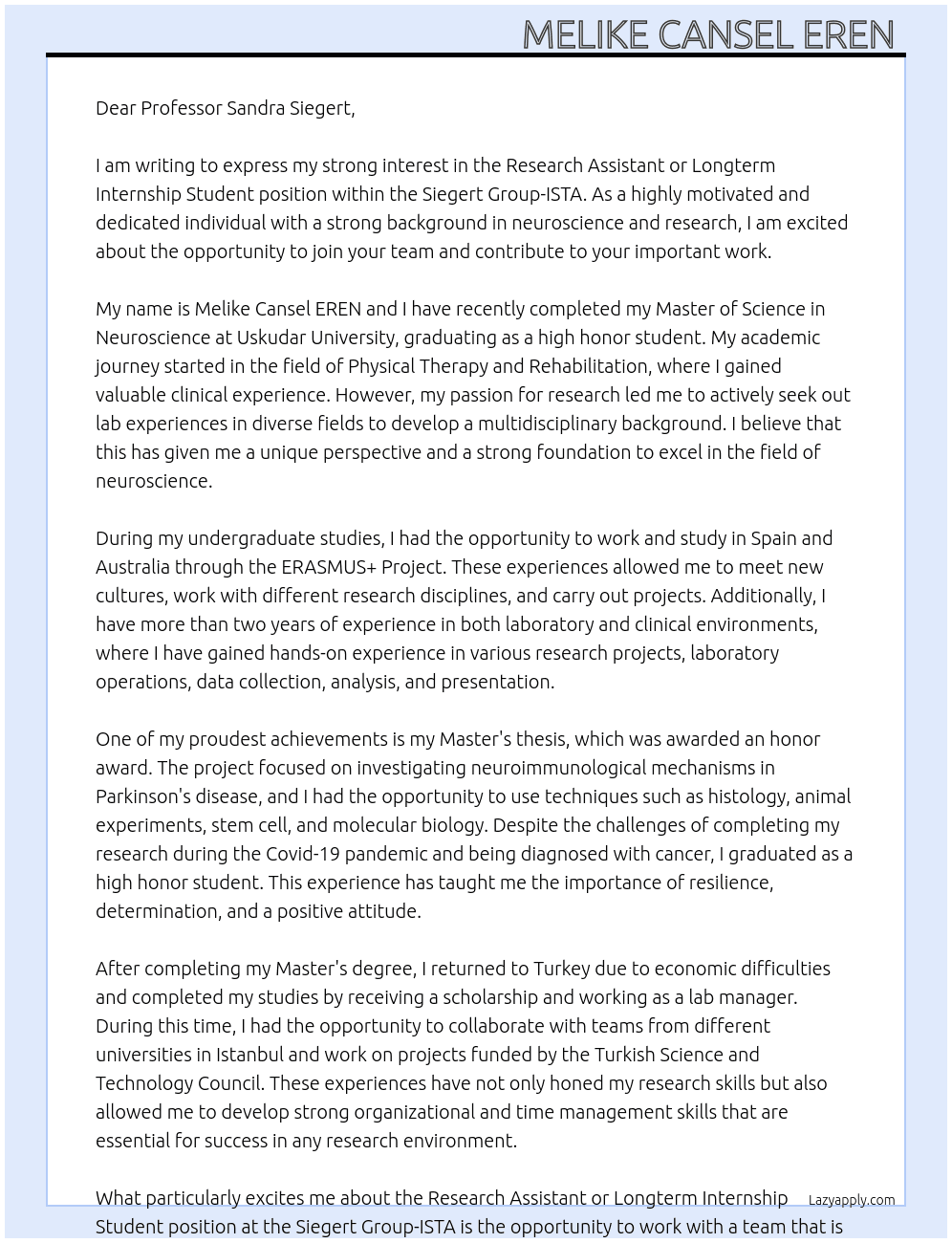
Dear Professor Sandra Siegert,
I am writing to express my strong interest in the Research Assistant or Longterm Internship Student position within the Siegert Group-ISTA. As a highly motivated and dedicated individual with a strong background in neuroscience and research, I am excited about the opportunity to join your team and contribute to your important work.
My name is Melike Cansel EREN and I have recently completed my Master of Science in Neuroscience at Uskudar University, graduating as a high honor student. My academic journey started in the field of Physical Therapy and Rehabilitation, where I gained valuable clinical experience. However, my passion for research led me to actively seek out lab experiences in diverse fields to develop a multidisciplinary background. I believe that this has given me a unique perspective and a strong foundation to excel in the field of neuroscience.
During my undergraduate studies, I had the opportunity to work and study in Spain and Australia through the ERASMUS+ Project. These experiences allowed me to meet new cultures, work with different research disciplines, and carry out projects. Additionally, I have more than two years of experience in both laboratory and clinical environments, where I have gained hands-on experience in various research projects, laboratory operations, data collection, analysis, and presentation.
One of my proudest achievements is my Master's thesis, which was awarded an honor award. The project focused on investigating neuroimmunological mechanisms in Parkinson's disease, and I had the opportunity to use techniques such as histology, animal experiments, stem cell, and molecular biology. Despite the challenges of completing my research during the Covid-19 pandemic and being diagnosed with cancer, I graduated as a high honor student. This experience has taught me the importance of resilience, determination, and a positive attitude.
After completing my Master's degree, I returned to Turkey due to economic difficulties and completed my studies by receiving a scholarship and working as a lab manager. During this time, I had the opportunity to collaborate with teams from different universities in Istanbul and work on projects funded by the Turkish Science and Technology Council. These experiences have not only honed my research skills but also allowed me to develop strong organizational and time management skills that are essential for success in any research environment.
What particularly excites me about the Research Assistant or Longterm Internship Student position at the Siegert Group-ISTA is the opportunity to work with a team that is pioneering research on microglia-neuron interaction and its impact on brain function. I am fascinated by the idea of exploring how environmental cues, such as drugs, extracellular matrix, sex, and metabolic insults, can modulate microglia response and ultimately affect neuronal circuit function and behavior. I am also drawn to the interdisciplinary approach of your research, which incorporates live imaging, electrophysiological/cellular, molecular, and behavioral analysis, as well as biophysics, mathematics, and machine learning.
As a candidate, I bring a diverse set of skills and qualifications to the table. I have a strong ability to work independently and efficiently, with excellent organizational and task prioritization skills. My communication skills are well-developed, and I am proficient in performing administrative and clerical tasks. I am also highly proficient in general laboratory procedures, techniques, and documentation, and I am always eager to learn and adapt to new techniques and technologies. Additionally, I am fluent in English, Spanish, French, and Catalan, which will be valuable in collaborating with a diverse team.
My experience in conducting animal experiments, behavioral experiments, anatomical dissection, and molecular analysis, as well as my advanced knowledge and experience in 3D cell culture techniques, protein isolation, Western Blot, PCR, rt-qPCR, toxicity testing, IHC, Northern Blot, and ELISA, make me well-equipped to contribute to the research goals of the Siegert Group. I am also proficient in using various software programs, including Microsoft Office Suite, SPSS, MATLAB, and Python, which will be valuable in data analysis.
Finally, I want to mention that my background has taught me to be a kind, patient, and hardworking person. Growing up as the first generation in my family to attend university, I have learned to overcome challenges and balance work and life responsibilities. Unfortunately, I had to provide for my father after losing my mother at a young age, and I have been working part-time as a researcher and physiotherapist to support my education. These experiences have taught me the importance of discipline, and I am confident that I will bring a strong work ethic to the Siegert Group.
In closing, I am enthusiastic about the opportunity to join the Siegert Group and contribute to your groundbreaking research. I am confident that my skills, qualifications, and motivation make me a strong candidate for this position, and I am eager to discuss my application further.
Thank you for considering my application. I look forward to the opportunity to meet with you and discuss how I can contribute to the success of the Siegert Group.
Sincerely,
Melike Cansel EREN