
Urban Resilience Expert Cover Letter Examples And Template
Check out these urban resilience expert cover letter sample and examples previously used by job seekers to land on job interviews as urban resilience expert. Use our AI cover letter generator to create a personalized cover letter as urban resilience expert.
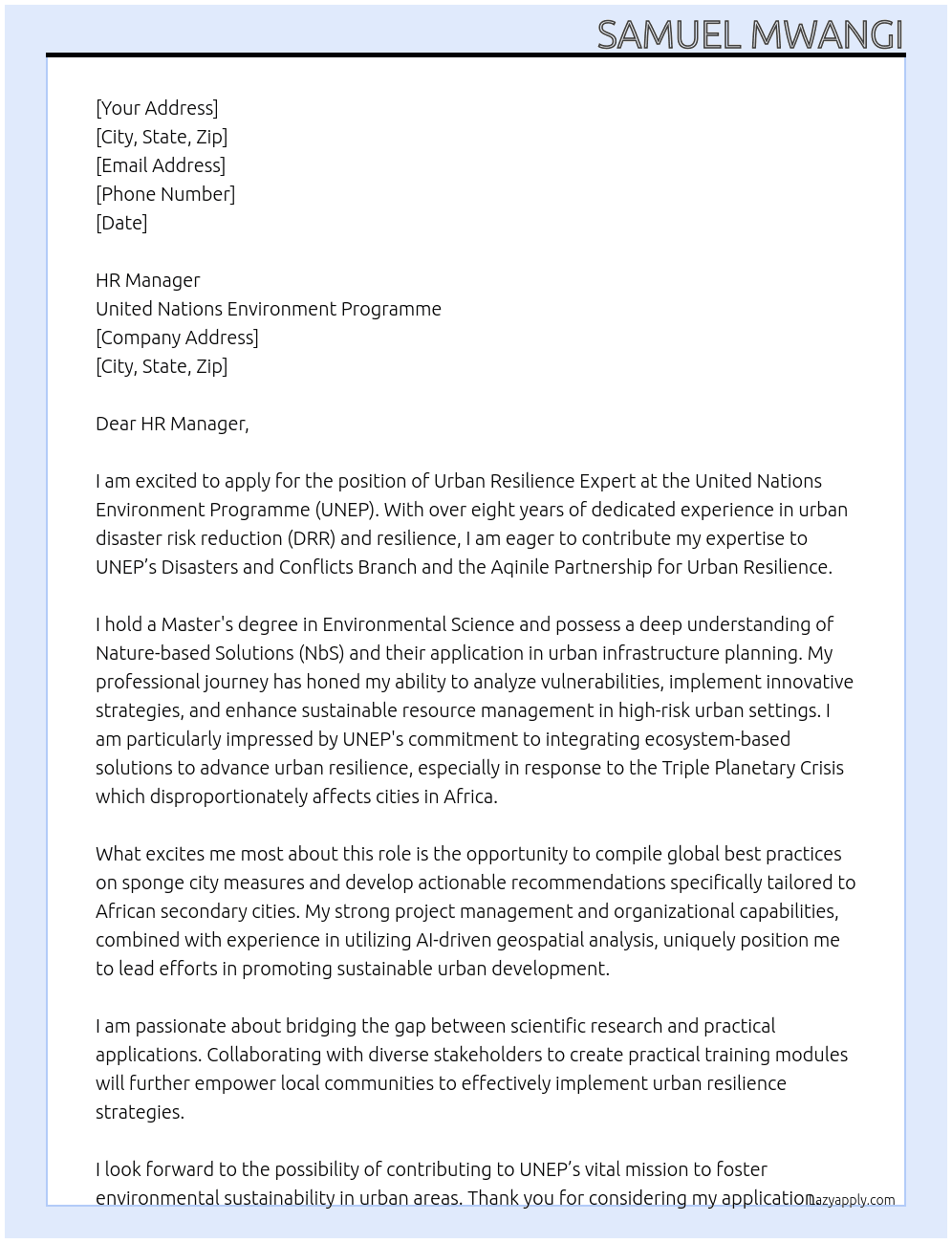
Urban Resilience Expert Cover Letter Examples
Urban Resilience Expert Cover Letter At United Nations Environment Programme
United Nations Environment Programme
nairobi
The United Nations Environment Programme (UNEP) serves as the leading global environmental authority
setting the global environmental agenda
fostering the coherent implementation of sustainable development
and advocating for environmental protection worldwide. UNEP’s Disasters and Conflicts Branch is dedicated to mitigating environmental risks before
during
and after conflicts and disasters. Through scientific assessments
policy guidance
and capacity-building efforts
the branch helps nations build environmental resilience while integrating sustainable natural resource management into peacebuilding and recovery strategies. Working in close partnership with governments
UN agencies
and civil society
UNEP’s Disasters and Conflicts Branch strengthens post-crisis recovery
disaster risk reduction
and climate security
fostering long-term environmental sustainability in fragile and conflict-affected regions. Within this Branch
the Disaster Risk Reduction (DRR) Unit plays a pivotal role in advancing disaster risk reduction. By leading UNEP’s contributions to the Sendai Framework
this unit promotes ecosystem-based solutions to disaster risk and actively supports urban resilience by advancing Nature-based Solutions (NbS) that reduce disaster risks while delivering additional benefits for climate adaptation
biodiversity conservation
and sustainable development in urban areas. UNEP
through its Disaster Risk Reduction (DRR) Unit
is part of the Aqinile Partnership for Urban Resilience—a collaborative initiative with the African Union
UN-Habitat
UNDP and UNEP. The partnership is dedicated to supporting urban communities in Africa in reducing disaster risk
building climate resilience
and advancing sustainable urban development. As cities across the world grapple with the Triple Planetary Crisis (climate change
biodiversity loss
and pollution) the integration of environmental sustainability into urban planning has become an urgent priority. African cities
in particular
face heightened disaster risks due to rapid urbanization
environmental degradation
and climate change. Many urban areas are expanding into high-risk zones
which increases their vulnerability to extreme weather events. Work Assignments & Outputs - Work Assignments: 1. A Compilation of Existing Case Studies/ Best Practices on Sponge City Measures The Consultant is expected to produce a global Compilation of Sponge City Measures that highlights good practices
common challenges
and lessons learned from past and ongoing sponge city interventions. The compilation should aim to improve understanding of how Nature-based Solutions (NbS) contribute to the sponge city approach and identify characteristics of scalable NbS typologies that enhance urban resilience—particularly in flood-prone and water-stressed environments. The document should include a diverse range of case studies
drawn from global experiences
with attention to practical applications
institutional arrangements
and enabling conditions for replication. It should also identify gaps and barriers to implementation
with a view to informing policy and planning processes. While global in scope
the compilation will serve as a key input to the Aqinile Partnership’s Sponge City Initiative in secondary cities in Africa
supporting efforts to localize and adapt successful approaches for maximum impact. 2. Actionable recommendations for implementation of Sponge City measures in African secondary cities The Consultant will analyze and summarize the key barriers and enabling conditions for scaling up Nature-based Solutions (NbS) and sponge city measures
as identified through the compilation of case studies. Particular attention should be given to assessing the relevance and adaptability of these measures—many of which have been developed in larger cities of the Global North—to the realities and constraints of secondary cities in Africa. The Consultant will identify key policies
strategies
and regulatory frameworks at regional
national
and city levels that could support the integration of sponge city approaches in African urban contexts. Based on this analysis
the Consultant is expected to develop practical recommendations for incorporating sponge city principles into local policies
planning instruments
standards
and financing mechanisms
with a view to enabling the implementation of the shortlisted measures in the compilation. To support this process
the Consultant will organize a validation workshop (modality TBD) with relevant stakeholders. This consultation will serve to review the draft recommendations
prioritize context-appropriate interventions
and ensure that the final product reflects the specific needs
opportunities
and institutional realities of secondary cities in Africa. 3. Utilize AI-driven and remote sensing geospatial analysis
flood risk assessments
and/ or hydrological modelling to evaluate existing grey
blue
and green infrastructure in selected African secondary cities
and to identify gaps and opportunities for sponge city implementation in African secondary cities The consultant is expected to undertake hydrological modelling to simulate the movement of water throughout the hydrological cycle. This will involve the use of AI
remote sensing
and GIS tools to support advanced mathematical models that accurately represent the interactions among key processes such as rainfall
runoff
infiltration
evapotranspiration
and groundwater flow. The consultant will be responsible for calibrating and validating the model using available datasets and ensuring that the outputs are reliable and suitable for decision-making purposes. As part of the engagement
the consultant is also expected to conduct detailed flood studies using the hydrological models developed. This will include assessing the magnitude and frequency of flood events
identifying flood-prone areas
and analyzing various hydrological scenarios. As a result
the consultant will carry out a flood risk assessment to systematically identify and analyze exposure and vulnerabilities
quantify associated risks
and evaluate the potential impacts of flooding. This will involve mapping flood hazards. In addition
the consultant will identify gaps in existing grey
blue
and green infrastructure and propose integrated
context-specific solutions to address these gaps in alignment with the sponge city approach. The findings from the flood risk assessment and infrastructure gap analysis will inform strategies for flood risk management and support decision-making related to land use planning
infrastructure development
and disaster preparedness through the application of Nature-based Solutions within the sponge city framework. Exact cities and their number to be determined in discussion with the Consultant. 4. Sponge City Masterclass Training Module The Consultant is expected to develop a Masterclass Training Module on sponge city measures in African secondary cities. This will help ensure training participants are provided with guidance on real world applications of the sponge city concept and have enhanced capacity on how to implement sponge city measures in secondary cities. This module will be delivered during a Training-of-Trainers
targeting city planning
architecture
engineering
environment and climate change specialist staff both at the national and city/municipal levels. The training will be presented in a PowerPoint (ppt) format and should be accompanied by a training manual with recommended reading materials and other resources. Qualifications/special skills At least a master’s degree in environmental engineering
Geomatics
Urban Development
Landscape Architecture
Environmental Science
Ecology
International Development
or a field related NbS and Ecosystem-based DRR Skills & Competencies: • Practice-research-innovation skills • Excellent project management and organizational skills • Ability to develop and implement capacity-building initiatives • Strong analytical
report-writing
and presentation skills A minimum of 8 years’ experience in the field on Urban DRR and Resilience; Experience and project references related to integration of NbS into urban infrastructure planning
design
and implementation; Proficiency in sustainable urban development principles and practices; Familiarity with environmental science and ecology with a deep understanding of NbS and their environmental impacts. Experience in working in Africa is an asse
By samuel mwangi
[Your Address]
[City, State, Zip]
[Email Address]
[Phone Number]
[Date]
HR Manager
United Nations Environment Programme
[Company Address]
[City, State, Zip]
Dear HR Manager,
I am excited to apply for the position of Urban Resilience Expert at the United Nations Environment Programme (UNEP). With over eight years of dedicated experience in urban disaster risk reduction (DRR) and resilience, I am eager to contribute my expertise to UNEP’s Disasters and Conflicts Branch and the Aqinile Partnership for Urban Resilience.
I hold a Master's degree in Environmental Science and possess a deep understanding of Nature-based Solutions (NbS) and their application in urban infrastructure planning. My professional journey has honed my ability to analyze vulnerabilities, implement innovative strategies, and enhance sustainable resource management in high-risk urban settings. I am particularly impressed by UNEP's commitment to integrating ecosystem-based solutions to advance urban resilience, especially in response to the Triple Planetary Crisis which disproportionately affects cities in Africa.
What excites me most about this role is the opportunity to compile global best practices on sponge city measures and develop actionable recommendations specifically tailored to African secondary cities. My strong project management and organizational capabilities, combined with experience in utilizing AI-driven geospatial analysis, uniquely position me to lead efforts in promoting sustainable urban development.
I am passionate about bridging the gap between scientific research and practical applications. Collaborating with diverse stakeholders to create practical training modules will further empower local communities to effectively implement urban resilience strategies.
I look forward to the possibility of contributing to UNEP’s vital mission to foster environmental sustainability in urban areas. Thank you for considering my application.
Sincerely,
Samuel Mwangi