
Head Teacher Cover Letter Examples And Template
Check out these head teacher cover letter sample and examples previously used by job seekers to land on job interviews as head teacher. Use our AI cover letter generator to create a personalized cover letter as head teacher.
Head Teacher Cover Letter Examples
head teacher Cover Letter At Edinburgh new town coooking school
Edinburgh new town coooking school
By adam abbott
[Your Address]
[City, State, Zip Code]
[Email Address]
[Phone Number]
[Date]
Manager
Edinburgh New Town Cooking School
[Company Address]
[City, State, Zip Code]
Dear Manager,
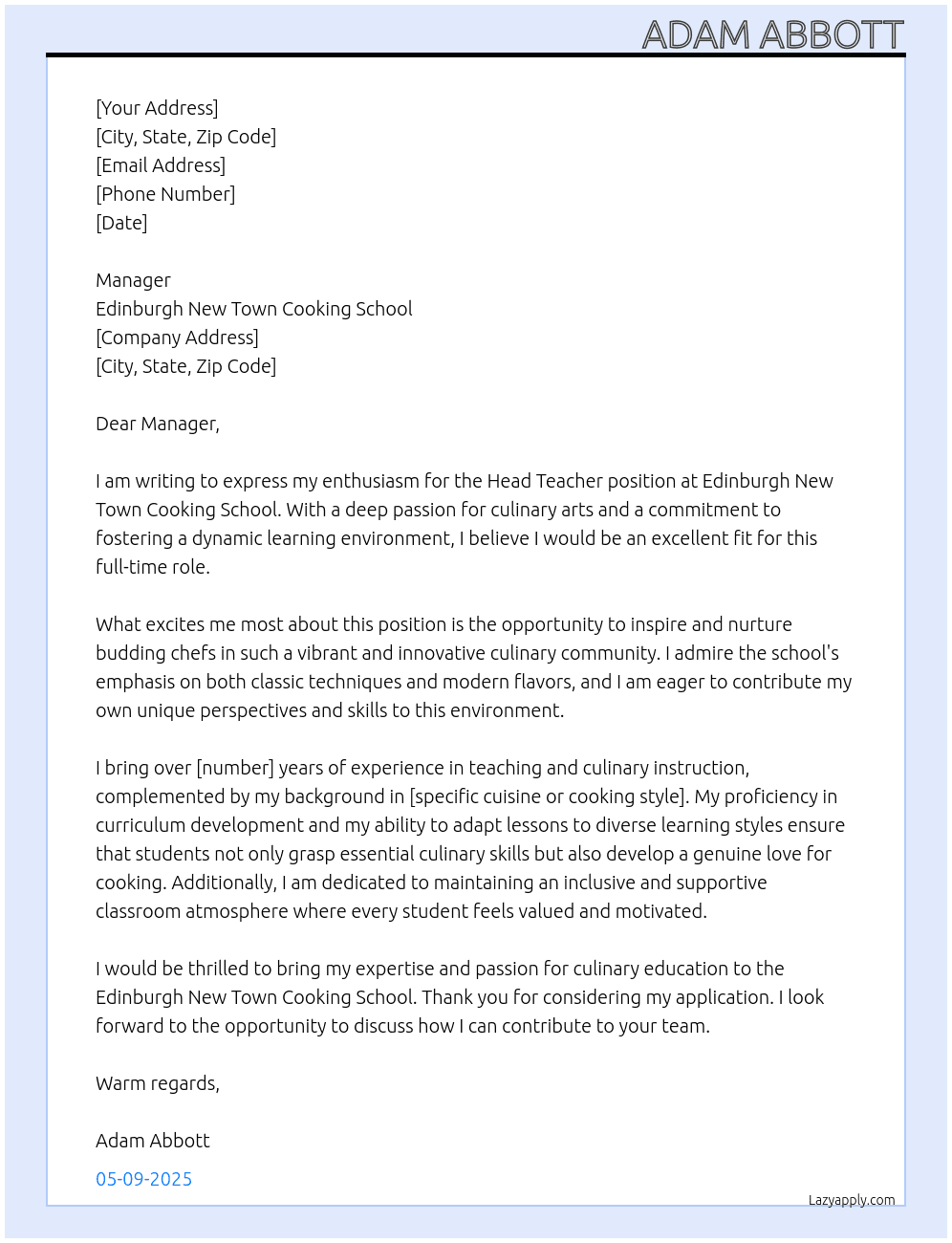
I am writing to express my enthusiasm for the Head Teacher position at Edinburgh New Town Cooking School. With a deep passion for culinary arts and a commitment to fostering a dynamic learning environment, I believe I would be an excellent fit for this full-time role.
What excites me most about this position is the opportunity to inspire and nurture budding chefs in such a vibrant and innovative culinary community. I admire the school's emphasis on both classic techniques and modern flavors, and I am eager to contribute my own unique perspectives and skills to this environment.
I bring over [number] years of experience in teaching and culinary instruction, complemented by my background in [specific cuisine or cooking style]. My proficiency in curriculum development and my ability to adapt lessons to diverse learning styles ensure that students not only grasp essential culinary skills but also develop a genuine love for cooking. Additionally, I am dedicated to maintaining an inclusive and supportive classroom atmosphere where every student feels valued and motivated.
I would be thrilled to bring my expertise and passion for culinary education to the Edinburgh New Town Cooking School. Thank you for considering my application. I look forward to the opportunity to discuss how I can contribute to your team.
Warm regards,
Adam Abbott
HEAD TEACHER Cover Letter At Government
Government
10 years in teaching
good editing and computer skills
handling journalism club over 5 years
training and developing future writers
30 units in graduate school
By MR. CRUZ
[Your Name]
[Address]
[City, State ZIP Code]
[Email Address]
[Today’s Date]
[Employer’s Name]
[Company Name]
[Address]
[City, State ZIP Code]
Dear Mr. Cruz,
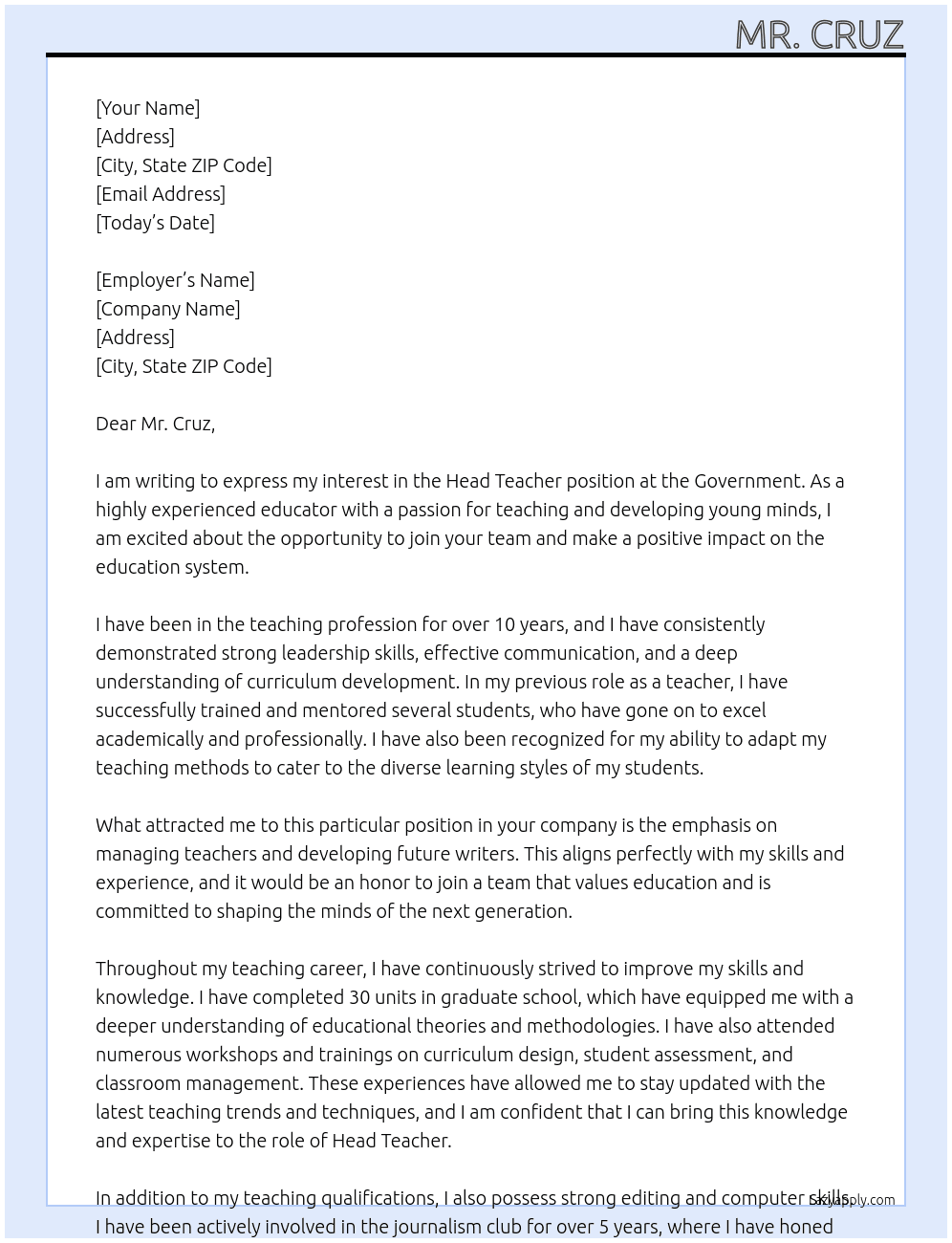
I am writing to express my interest in the Head Teacher position at the Government. As a highly experienced educator with a passion for teaching and developing young minds, I am excited about the opportunity to join your team and make a positive impact on the education system.
I have been in the teaching profession for over 10 years, and I have consistently demonstrated strong leadership skills, effective communication, and a deep understanding of curriculum development. In my previous role as a teacher, I have successfully trained and mentored several students, who have gone on to excel academically and professionally. I have also been recognized for my ability to adapt my teaching methods to cater to the diverse learning styles of my students.
What attracted me to this particular position in your company is the emphasis on managing teachers and developing future writers. This aligns perfectly with my skills and experience, and it would be an honor to join a team that values education and is committed to shaping the minds of the next generation.
Throughout my teaching career, I have continuously strived to improve my skills and knowledge. I have completed 30 units in graduate school, which have equipped me with a deeper understanding of educational theories and methodologies. I have also attended numerous workshops and trainings on curriculum design, student assessment, and classroom management. These experiences have allowed me to stay updated with the latest teaching trends and techniques, and I am confident that I can bring this knowledge and expertise to the role of Head Teacher.
In addition to my teaching qualifications, I also possess strong editing and computer skills. I have been actively involved in the journalism club for over 5 years, where I have honed my writing and editing abilities. I have also utilized technology in my teaching to create engaging and interactive lessons for my students. As Head Teacher, I am eager to introduce innovative teaching methods and incorporate technology in the classroom to enhance the learning experience for both students and teachers.
In my current role, I have also had the opportunity to mentor and guide new teachers, and I have found this experience extremely fulfilling. I believe that effective leadership is crucial in creating a positive and productive learning environment, and I am confident that my experience and skills make me an ideal candidate for the Managing Teachers role at Government.
Aside from my professional qualifications, I am also a dedicated and enthusiastic individual with excellent time-management and organizational skills. I am able to handle multiple tasks and responsibilities simultaneously, and I have a proven track record of meeting deadlines and achieving results. I am also a team player who thrives in a collaborative work environment and values open communication and feedback.
In conclusion, I am confident that my skills, experience, and passion for teaching make me a strong candidate for the Head Teacher position at Government. I am eager to bring my expertise and contribute to the growth and success of your organization. I look forward to the opportunity to discuss my application further and to learn more about the role and your expectations.
Thank you for considering my application. I am excited about the prospect of joining your team and making a positive impact in the education sector. I have attached my resume for your review, and I am available for an interview at your convenience.
Sincerely,
[Your Name]
HEAD TEACHER Cover Letter At Promotion
Promotion
By MR. CRUZ
Dear Mr. Cruz,
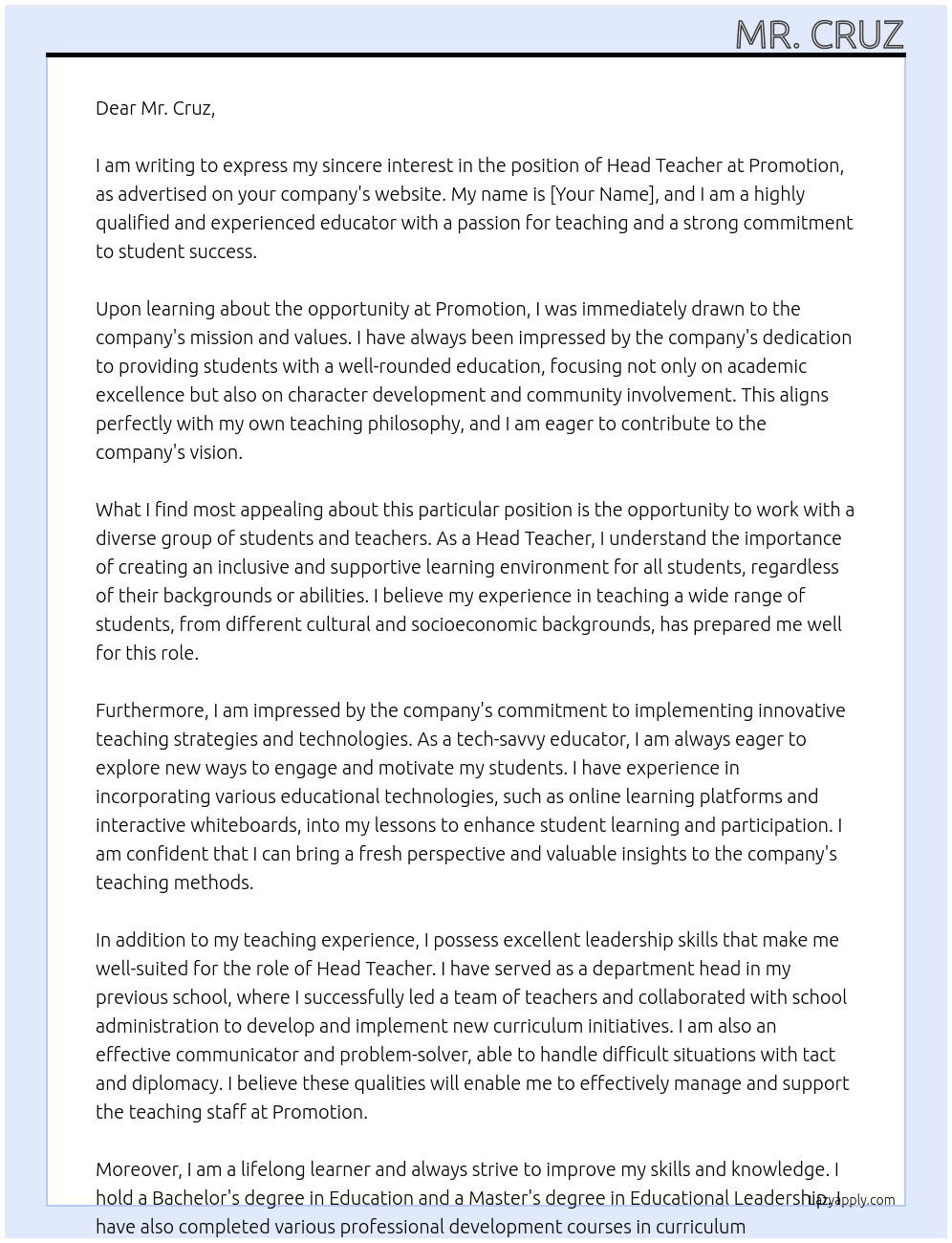
I am writing to express my sincere interest in the position of Head Teacher at Promotion, as advertised on your company's website. My name is [Your Name], and I am a highly qualified and experienced educator with a passion for teaching and a strong commitment to student success.
Upon learning about the opportunity at Promotion, I was immediately drawn to the company's mission and values. I have always been impressed by the company's dedication to providing students with a well-rounded education, focusing not only on academic excellence but also on character development and community involvement. This aligns perfectly with my own teaching philosophy, and I am eager to contribute to the company's vision.
What I find most appealing about this particular position is the opportunity to work with a diverse group of students and teachers. As a Head Teacher, I understand the importance of creating an inclusive and supportive learning environment for all students, regardless of their backgrounds or abilities. I believe my experience in teaching a wide range of students, from different cultural and socioeconomic backgrounds, has prepared me well for this role.
Furthermore, I am impressed by the company's commitment to implementing innovative teaching strategies and technologies. As a tech-savvy educator, I am always eager to explore new ways to engage and motivate my students. I have experience in incorporating various educational technologies, such as online learning platforms and interactive whiteboards, into my lessons to enhance student learning and participation. I am confident that I can bring a fresh perspective and valuable insights to the company's teaching methods.
In addition to my teaching experience, I possess excellent leadership skills that make me well-suited for the role of Head Teacher. I have served as a department head in my previous school, where I successfully led a team of teachers and collaborated with school administration to develop and implement new curriculum initiatives. I am also an effective communicator and problem-solver, able to handle difficult situations with tact and diplomacy. I believe these qualities will enable me to effectively manage and support the teaching staff at Promotion.
Moreover, I am a lifelong learner and always strive to improve my skills and knowledge. I hold a Bachelor's degree in Education and a Master's degree in Educational Leadership. I have also completed various professional development courses in curriculum development, classroom management, and student assessment. I am confident that my educational background and continuous learning will make me a valuable asset to your company.
I am also excited about the opportunity to work in a collaborative and supportive environment. From my research, I have learned that Promotion values teamwork and encourages professional growth and development. I am eager to be a part of such a positive and dynamic culture and contribute my skills and expertise to the team.
Thank you for considering my application. I am confident that my passion for teaching and my qualifications make me a strong candidate for the Head Teacher position at Promotion. I am excited about the possibility of joining your team and would welcome the opportunity to discuss my application further.
Sincerely,
[Your Name]
HEAD TEACHER Cover Letter At DEPED
DEPED
By MR. CRUZ
[Your Name]
[Address]
[City, State ZIP Code]
[Email Address]
[Today’s Date]
[Mr./Ms. Hermoso]
[Position]
[Company Name]
[Address]
[City, State ZIP Code]
Dear Mr. Hermoso,
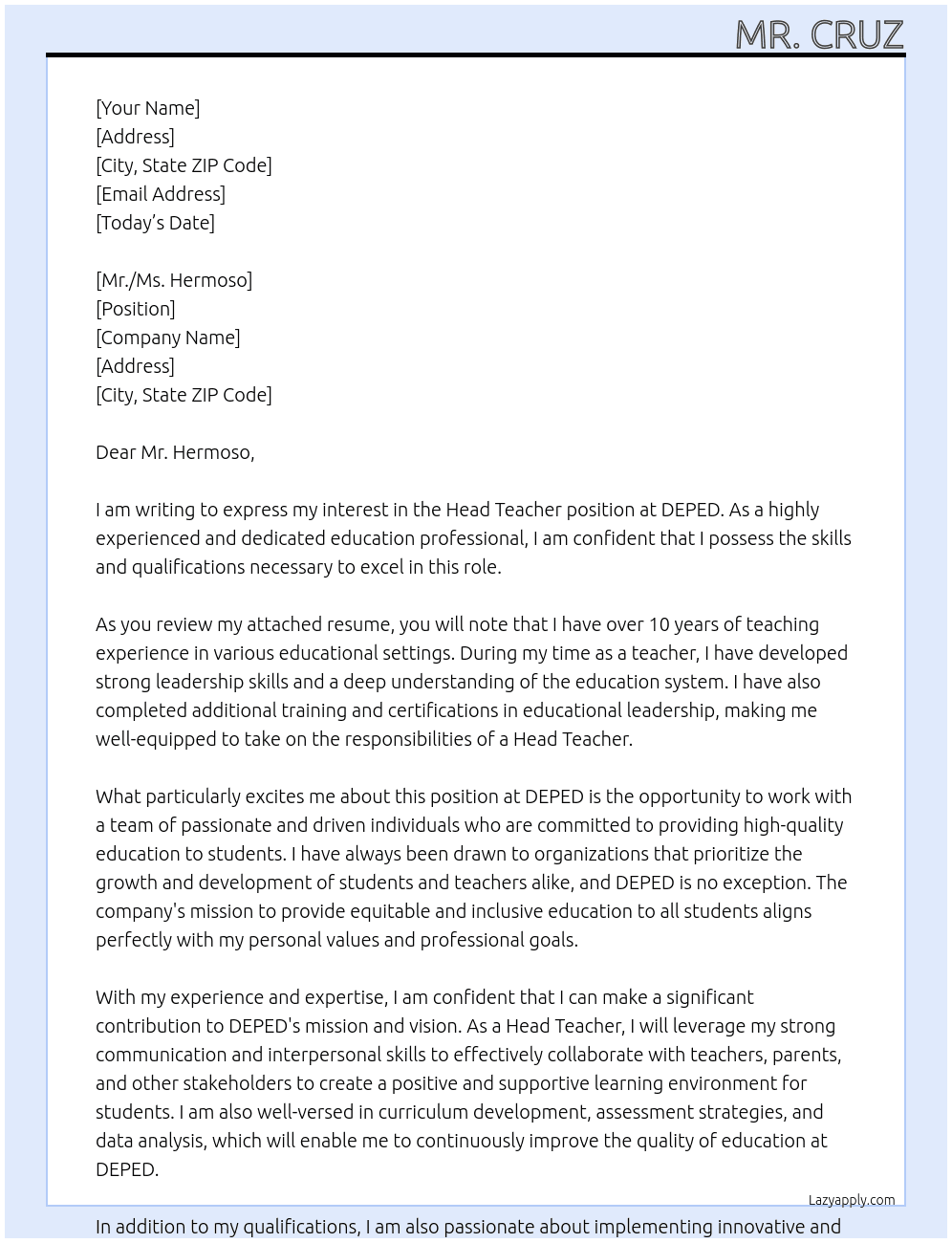
I am writing to express my interest in the Head Teacher position at DEPED. As a highly experienced and dedicated education professional, I am confident that I possess the skills and qualifications necessary to excel in this role.
As you review my attached resume, you will note that I have over 10 years of teaching experience in various educational settings. During my time as a teacher, I have developed strong leadership skills and a deep understanding of the education system. I have also completed additional training and certifications in educational leadership, making me well-equipped to take on the responsibilities of a Head Teacher.
What particularly excites me about this position at DEPED is the opportunity to work with a team of passionate and driven individuals who are committed to providing high-quality education to students. I have always been drawn to organizations that prioritize the growth and development of students and teachers alike, and DEPED is no exception. The company's mission to provide equitable and inclusive education to all students aligns perfectly with my personal values and professional goals.
With my experience and expertise, I am confident that I can make a significant contribution to DEPED's mission and vision. As a Head Teacher, I will leverage my strong communication and interpersonal skills to effectively collaborate with teachers, parents, and other stakeholders to create a positive and supportive learning environment for students. I am also well-versed in curriculum development, assessment strategies, and data analysis, which will enable me to continuously improve the quality of education at DEPED.
In addition to my qualifications, I am also passionate about implementing innovative and engaging teaching methods to enhance student learning. I have experience in integrating technology into the classroom and creating individualized learning plans to meet the unique needs of each student. I believe that this approach will not only improve academic performance but also foster a love for learning among students.
Moreover, I am a strong advocate for continuous professional development. I constantly seek out new learning opportunities and stay updated with the latest educational trends and techniques. I am confident that my passion for learning and growth will be an asset to DEPED and its teachers.
I am also impressed by DEPED's commitment to creating a diverse and inclusive workplace. As a teacher, I have worked with students from diverse backgrounds, and I strongly believe that diversity brings unique perspectives and enriches the learning experience. I am excited about the opportunity to work with a diverse team of educators and contribute to creating an inclusive environment for students.
I am confident that my skills, experience, and passion make me a strong fit for the Head Teacher position at DEPED. I am eager to bring my expertise and contribute to the success of the company. I would welcome the opportunity to meet with you and discuss my qualifications in more detail.
Thank you for considering my application. I look forward to hearing from you soon.
Sincerely,
[Your Name]
Head Teacher Cover Letter At EIS International School
EIS International School
By Merish
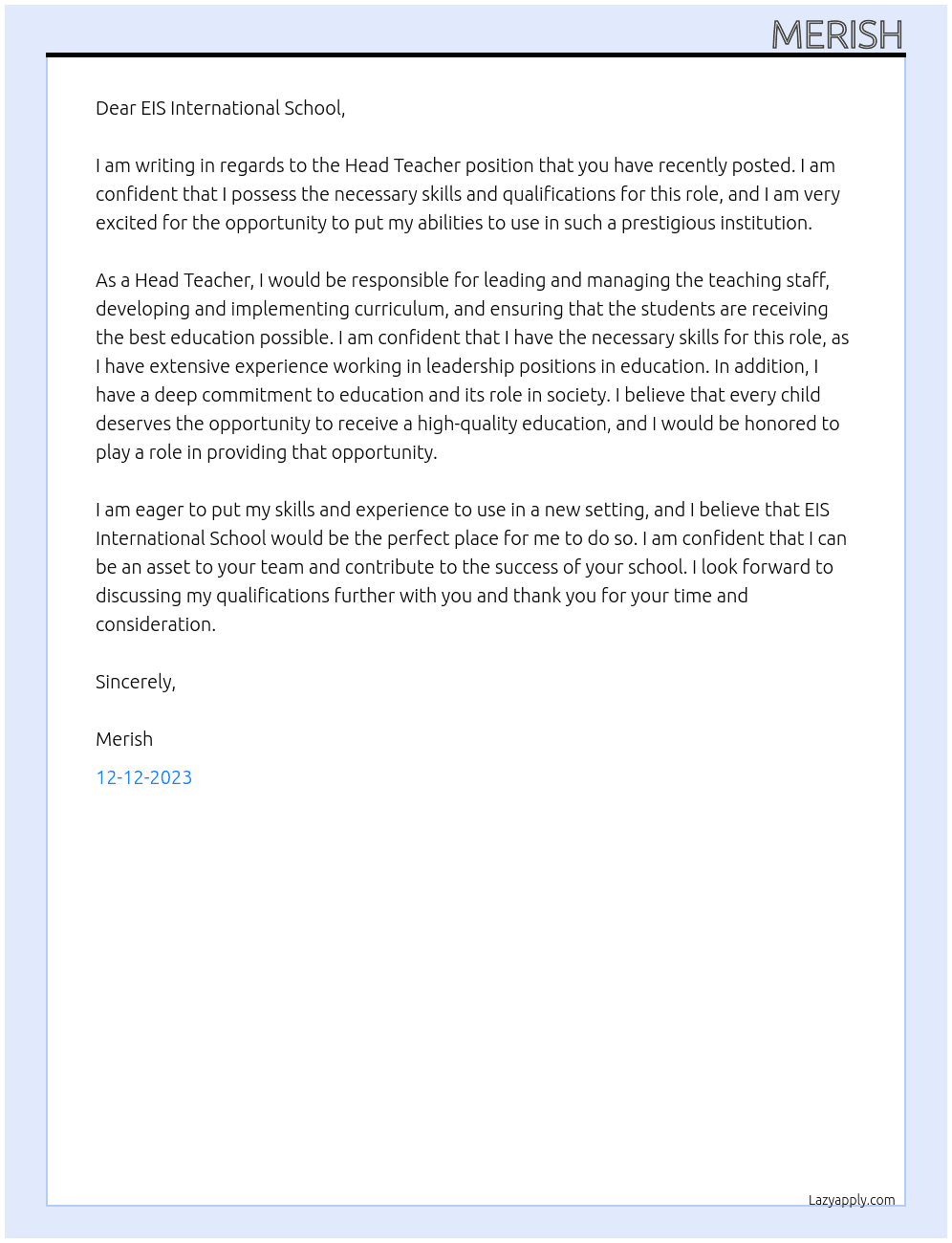
Dear EIS International School,
I am writing in regards to the Head Teacher position that you have recently posted. I am confident that I possess the necessary skills and qualifications for this role, and I am very excited for the opportunity to put my abilities to use in such a prestigious institution.
As a Head Teacher, I would be responsible for leading and managing the teaching staff, developing and implementing curriculum, and ensuring that the students are receiving the best education possible. I am confident that I have the necessary skills for this role, as I have extensive experience working in leadership positions in education. In addition, I have a deep commitment to education and its role in society. I believe that every child deserves the opportunity to receive a high-quality education, and I would be honored to play a role in providing that opportunity.
I am eager to put my skills and experience to use in a new setting, and I believe that EIS International School would be the perfect place for me to do so. I am confident that I can be an asset to your team and contribute to the success of your school. I look forward to discussing my qualifications further with you and thank you for your time and consideration.
Sincerely,
Merish
Head teacher Cover Letter At Repton College
Repton College
By Karen Smith
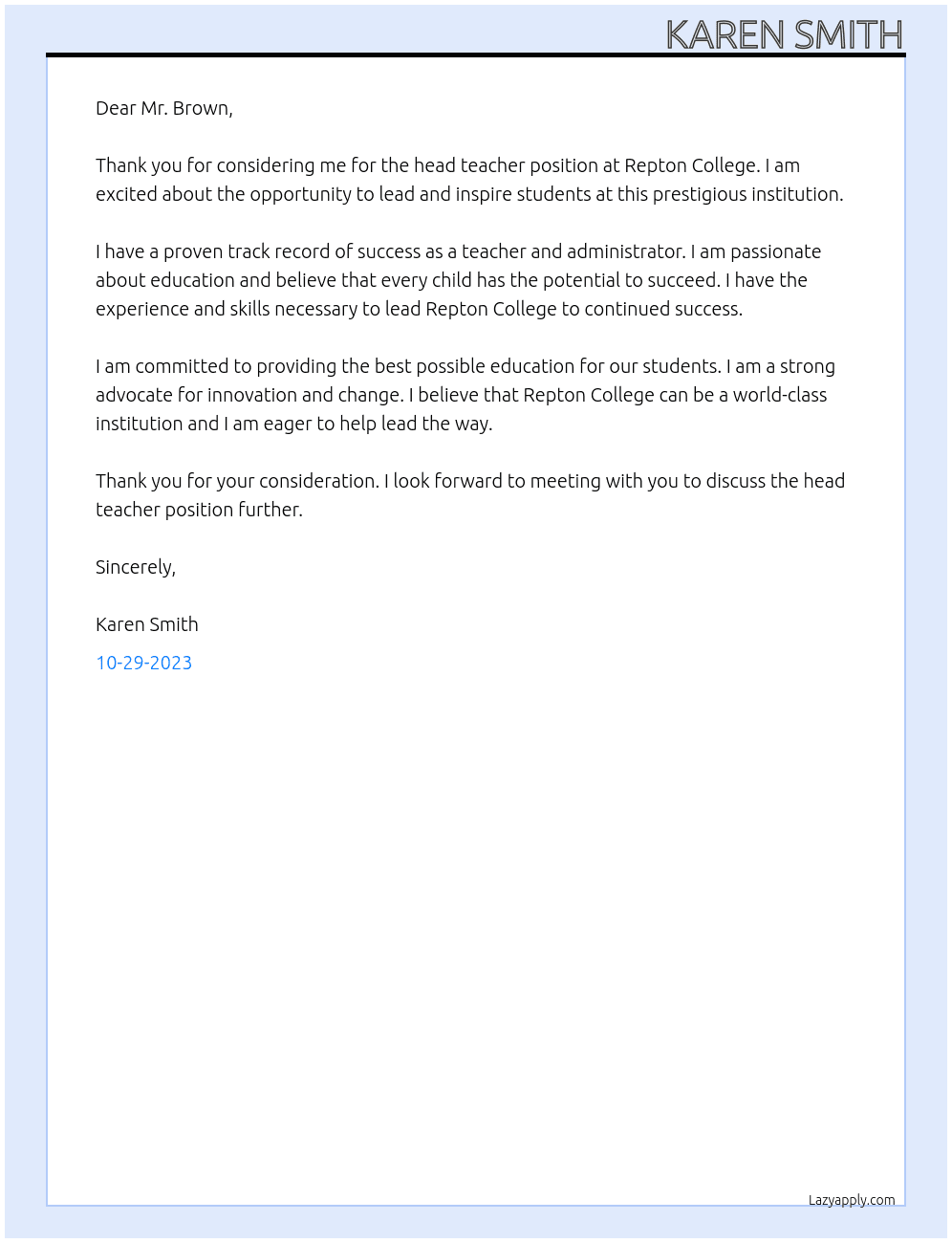
Dear Mr. Brown,
Thank you for considering me for the head teacher position at Repton College. I am excited about the opportunity to lead and inspire students at this prestigious institution.
I have a proven track record of success as a teacher and administrator. I am passionate about education and believe that every child has the potential to succeed. I have the experience and skills necessary to lead Repton College to continued success.
I am committed to providing the best possible education for our students. I am a strong advocate for innovation and change. I believe that Repton College can be a world-class institution and I am eager to help lead the way.
Thank you for your consideration. I look forward to meeting with you to discuss the head teacher position further.
Sincerely,
Karen Smith
Head TEacher Cover Letter At Department Of Education
Department Of Education
By NINA PANUGALINOG BORCES
[Your Name]
[Address]
[City, State ZIP Code]
[Email Address]
[Today’s Date]
[Department Head’s Name]
[Department]
[Name of Company]
[Address]
[City, State ZIP Code]
Dear [Department Head’s Name],
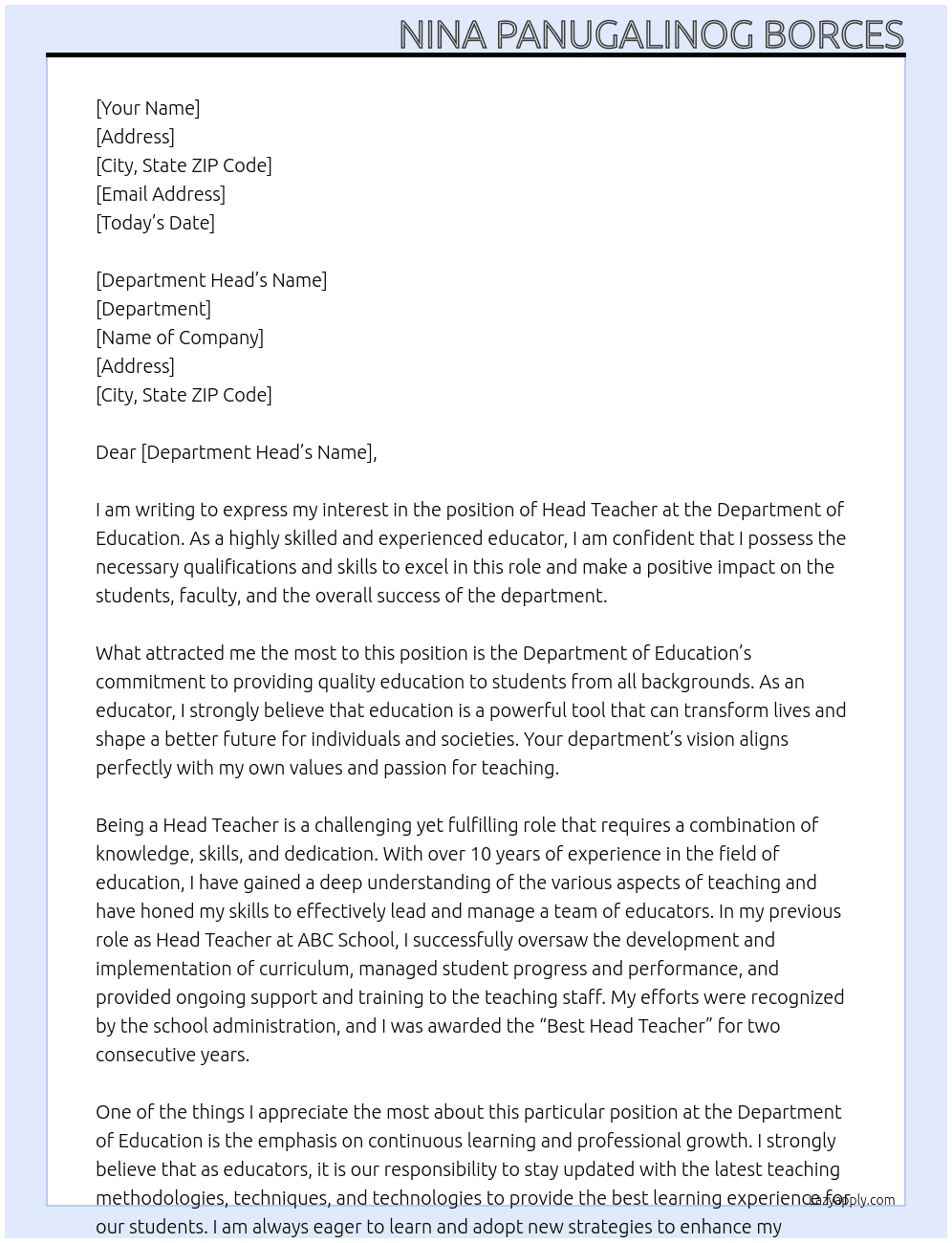
I am writing to express my interest in the position of Head Teacher at the Department of Education. As a highly skilled and experienced educator, I am confident that I possess the necessary qualifications and skills to excel in this role and make a positive impact on the students, faculty, and the overall success of the department.
What attracted me the most to this position is the Department of Education’s commitment to providing quality education to students from all backgrounds. As an educator, I strongly believe that education is a powerful tool that can transform lives and shape a better future for individuals and societies. Your department’s vision aligns perfectly with my own values and passion for teaching.
Being a Head Teacher is a challenging yet fulfilling role that requires a combination of knowledge, skills, and dedication. With over 10 years of experience in the field of education, I have gained a deep understanding of the various aspects of teaching and have honed my skills to effectively lead and manage a team of educators. In my previous role as Head Teacher at ABC School, I successfully oversaw the development and implementation of curriculum, managed student progress and performance, and provided ongoing support and training to the teaching staff. My efforts were recognized by the school administration, and I was awarded the “Best Head Teacher” for two consecutive years.
One of the things I appreciate the most about this particular position at the Department of Education is the emphasis on continuous learning and professional growth. I strongly believe that as educators, it is our responsibility to stay updated with the latest teaching methodologies, techniques, and technologies to provide the best learning experience for our students. I am always eager to learn and adopt new strategies to enhance my teaching skills, and I am confident that working at the Department of Education will provide me with ample opportunities to do so.
As a Head Teacher, I am not only responsible for the academic development of my students but also for their overall well-being. I strive to create a safe, inclusive, and nurturing learning environment where students feel valued and motivated to reach their full potential. My excellent communication skills, patience, and ability to connect with students of different ages and backgrounds have helped me build strong relationships with my students and their families. I am committed to promoting a positive school culture and fostering a sense of community within the department.
In addition to my teaching experience, I hold a Bachelor’s degree in Education and a Master’s degree in Curriculum and Instruction. I am also a certified teacher with a valid teaching license. My educational background, combined with my experience, has equipped me with a strong foundation in teaching theories and practical knowledge in curriculum development, assessment, and instructional strategies. I have also attended numerous workshops and training sessions on topics such as classroom management, differentiated instruction, and integrating technology in teaching.
I am excited about the opportunity to bring my skills, experience, and passion for teaching to the Department of Education. I am confident that my qualifications and dedication make me a strong candidate for this position, and I am eager to contribute to the department’s success.
Thank you for considering my application. I look forward to the opportunity to discuss my qualifications further and how I can contribute to the department’s goals and objectives.
Sincerely,
[Your Name]
Head Teacher Cover Letter At MCFG
MCFG
One of the best ways to raise tolerant
accepting and empathetic children ready to thrive in life is to start early
incorporating inclusion and anti-bias into early childhood education curriculum for infants
toddlers and their families. incorporate songs
storytelling and books into the curriculum. developing a child’s sense of confidence in their personal and social identities capacity to help a child recognize how they are simultaneously different and similar to others
which helps children foster an ability to comfortably and empathetically engage with people from all backgrounds. focus on respect and appreciation for inclusion our strength comes from our diversity supporting positive identity development develop an ability to understand multiple perspectives
and build the confidence to think critically and independently learning about families
friends
and their community. Through these explorations
students develop an understanding of themselves and a sense of self. Additionally
students explore concepts around similarities and differences
fairness and unfairness
explore diversity through books
conversation
classroom guests
and the arts. have a safe place to learn and take risks How can we take care of each other? observable physical features
such as skin tone
facial features
and hair texture. stands up and speaks out in support of another person. creating environments in which an individual or group can be and feel welcomed
respected
and supported in a way that allows them to fully participate. everybody is different and everyone is constantly growing and changing at their own pace Children come to learn more about their own strengths and abilities commitment to the creation of inclusive and equitable preschool settings remains core to ensuring students’ academic success and social enrichment. Promoting diversity and inclusion within the classroom is a catalyst for meeting developmental milestones and promoting greater social understanding and equity create more diverse
inclusive and equitable learning environments for young children. when children are exposed to diversity at an early age
they acquire stronger social and emotional skills and increase their awareness and understanding of diverse perspectives and cultures Promoting diverse and inclusive preschool settings
positively impacts children’s relationships with others
builds their self-confidence
and supports their understanding of similarities and differences among their peers and within their communities. multiple languages are encouraged in the classroom
By Josh
Debbie Byran
Head Teacher
MCFG Preschool
123 Main Street
Anytown, USA 12345
Dear Ms. Byran,
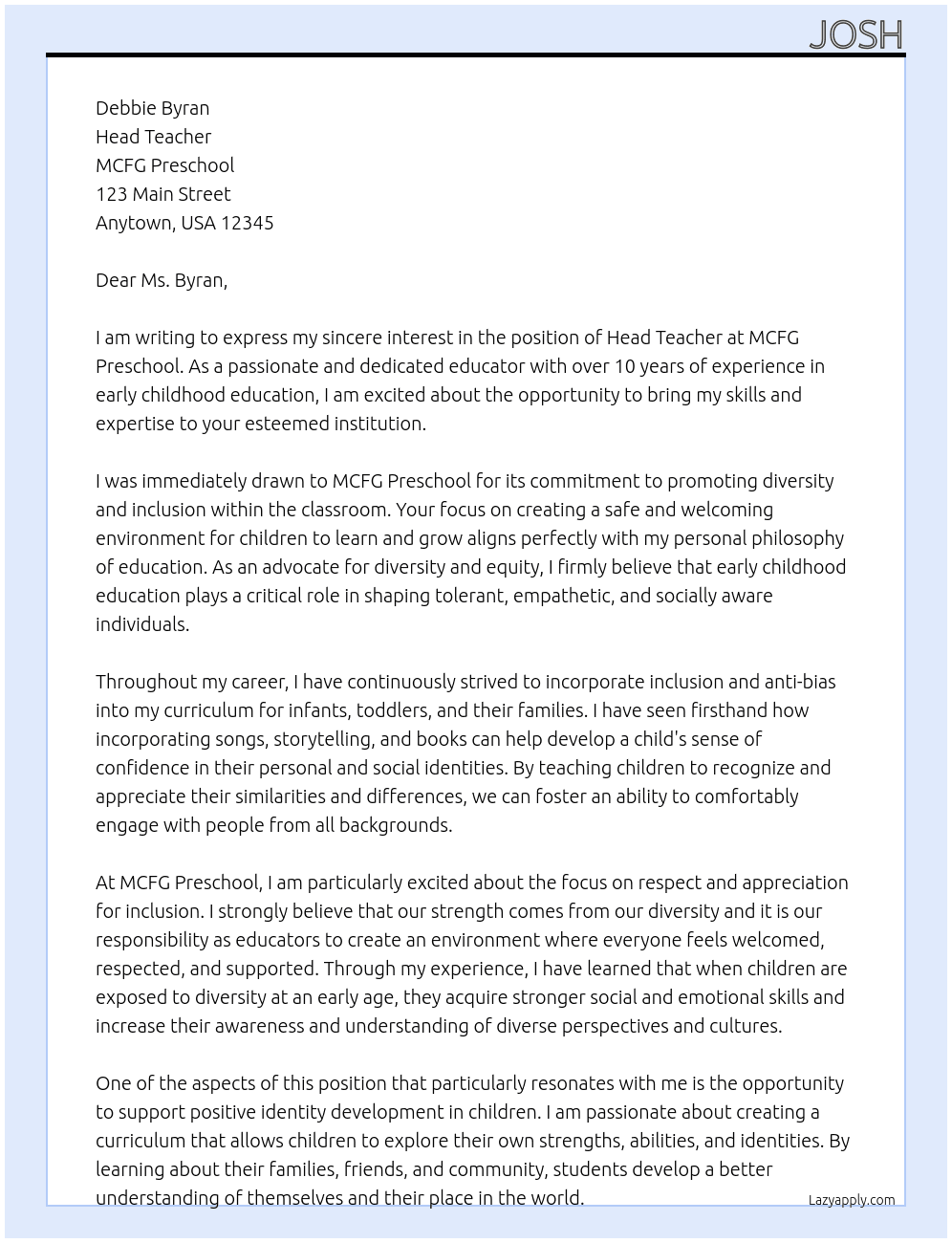
I am writing to express my sincere interest in the position of Head Teacher at MCFG Preschool. As a passionate and dedicated educator with over 10 years of experience in early childhood education, I am excited about the opportunity to bring my skills and expertise to your esteemed institution.
I was immediately drawn to MCFG Preschool for its commitment to promoting diversity and inclusion within the classroom. Your focus on creating a safe and welcoming environment for children to learn and grow aligns perfectly with my personal philosophy of education. As an advocate for diversity and equity, I firmly believe that early childhood education plays a critical role in shaping tolerant, empathetic, and socially aware individuals.
Throughout my career, I have continuously strived to incorporate inclusion and anti-bias into my curriculum for infants, toddlers, and their families. I have seen firsthand how incorporating songs, storytelling, and books can help develop a child's sense of confidence in their personal and social identities. By teaching children to recognize and appreciate their similarities and differences, we can foster an ability to comfortably engage with people from all backgrounds.
At MCFG Preschool, I am particularly excited about the focus on respect and appreciation for inclusion. I strongly believe that our strength comes from our diversity and it is our responsibility as educators to create an environment where everyone feels welcomed, respected, and supported. Through my experience, I have learned that when children are exposed to diversity at an early age, they acquire stronger social and emotional skills and increase their awareness and understanding of diverse perspectives and cultures.
One of the aspects of this position that particularly resonates with me is the opportunity to support positive identity development in children. I am passionate about creating a curriculum that allows children to explore their own strengths, abilities, and identities. By learning about their families, friends, and community, students develop a better understanding of themselves and their place in the world.
In my previous roles, I have successfully incorporated diversity and inclusion into the curriculum through various methods such as books, conversations, classroom guests, and the arts. I firmly believe that we must create a safe place for children to learn and take risks while also promoting a sense of community and encouraging children to take care of each other. By exploring observable physical features, such as skin tone, facial features, and hair texture, we can help children understand and appreciate their differences.
Furthermore, I am skilled in creating environments where individuals and groups feel welcomed, respected, and supported. I have a proven track record of promoting diversity and inclusion within the classroom, which has positively impacted children's relationships with others, built their self-confidence, and supported their understanding of similarities and differences.
My commitment to the creation of inclusive and equitable preschool settings remains core to ensuring students' academic success and social enrichment. I believe that promoting diversity and inclusion within the classroom is a catalyst for meeting developmental milestones and promoting greater social understanding and equity. I am excited about the opportunity to join MCFG Preschool and contribute to creating more diverse, inclusive, and equitable learning environments for young children.
In addition to my extensive experience and skills, I am also fluent in multiple languages and strongly believe in encouraging children to embrace and celebrate their cultural backgrounds. I am confident that my ability to communicate in different languages will be an asset in promoting diversity and inclusion within the classroom.
I am thrilled at the prospect of joining your team and bringing my passion, skills, and experience to MCFG Preschool. I am confident that my dedication to promoting diversity and inclusion, along with my commitment to fostering a love for learning, will make me an asset to your institution.
Thank you for considering my application. I look forward to the opportunity to discuss my qualifications further.
Sincerely,
Josh
head teacher Cover Letter At Deped Zamboanga Sibugay Division
Deped Zamboanga Sibugay Division
By Ronie E. Ramiso
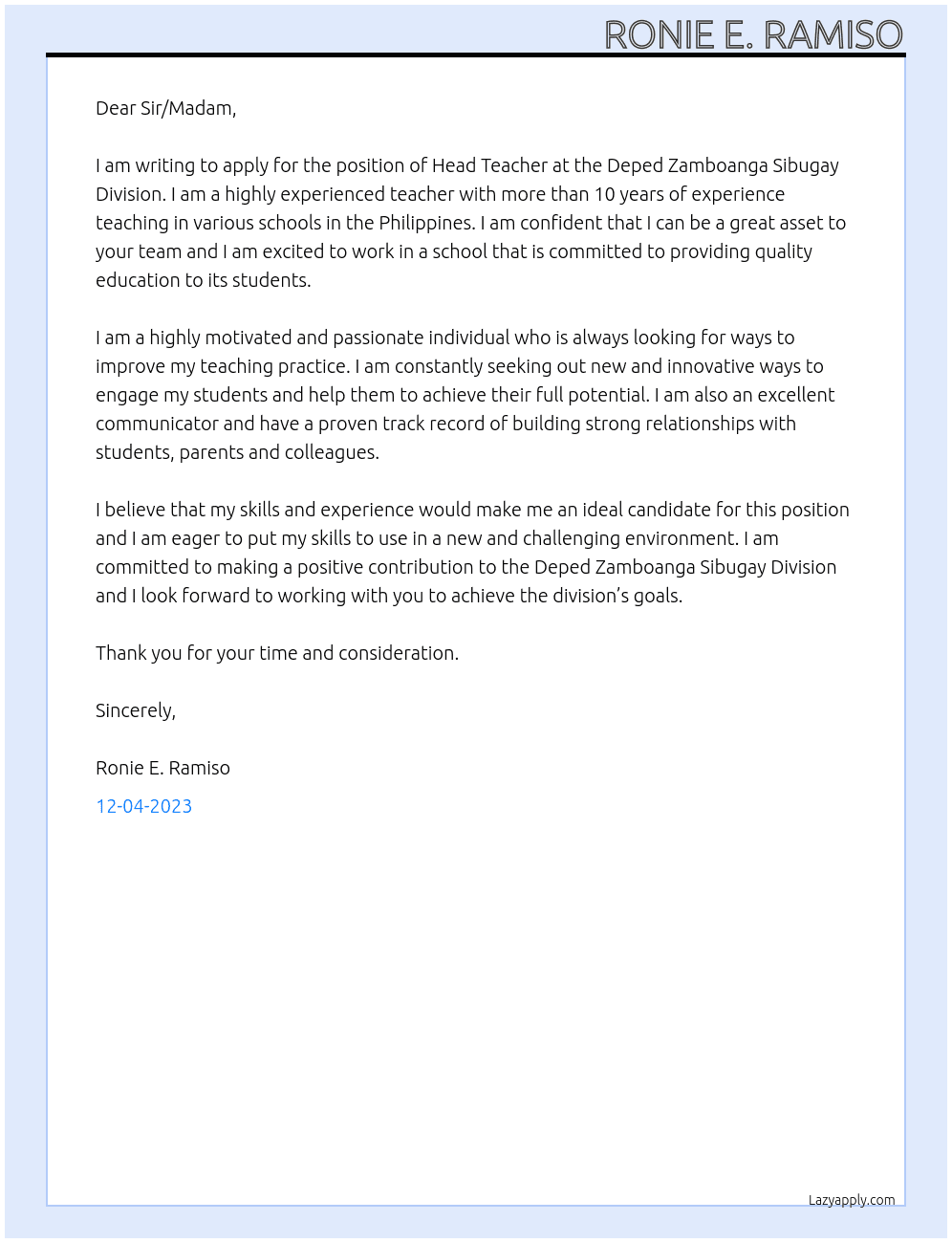
Dear Sir/Madam,
I am writing to apply for the position of Head Teacher at the Deped Zamboanga Sibugay Division. I am a highly experienced teacher with more than 10 years of experience teaching in various schools in the Philippines. I am confident that I can be a great asset to your team and I am excited to work in a school that is committed to providing quality education to its students.
I am a highly motivated and passionate individual who is always looking for ways to improve my teaching practice. I am constantly seeking out new and innovative ways to engage my students and help them to achieve their full potential. I am also an excellent communicator and have a proven track record of building strong relationships with students, parents and colleagues.
I believe that my skills and experience would make me an ideal candidate for this position and I am eager to put my skills to use in a new and challenging environment. I am committed to making a positive contribution to the Deped Zamboanga Sibugay Division and I look forward to working with you to achieve the division’s goals.
Thank you for your time and consideration.
Sincerely,
Ronie E. Ramiso
head teacher Cover Letter At Bronx charter school for excellence
Bronx charter school for excellence
By Kim Booker
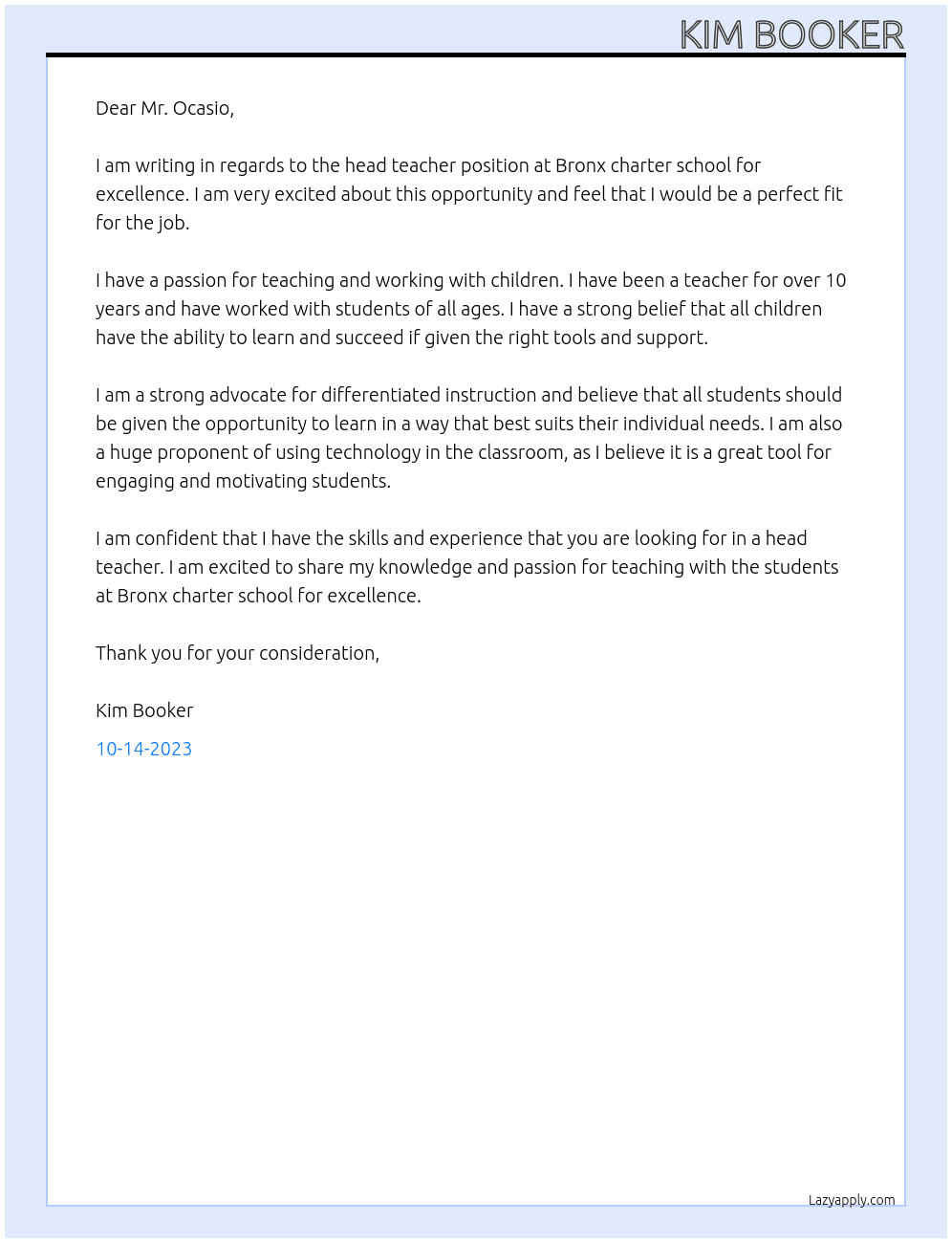
Dear Mr. Ocasio,
I am writing in regards to the head teacher position at Bronx charter school for excellence. I am very excited about this opportunity and feel that I would be a perfect fit for the job.
I have a passion for teaching and working with children. I have been a teacher for over 10 years and have worked with students of all ages. I have a strong belief that all children have the ability to learn and succeed if given the right tools and support.
I am a strong advocate for differentiated instruction and believe that all students should be given the opportunity to learn in a way that best suits their individual needs. I am also a huge proponent of using technology in the classroom, as I believe it is a great tool for engaging and motivating students.
I am confident that I have the skills and experience that you are looking for in a head teacher. I am excited to share my knowledge and passion for teaching with the students at Bronx charter school for excellence.
Thank you for your consideration,
Kim Booker