
Senior Human Resources Manager Cover Letter Examples And Template
Check out these senior human resources manager cover letter sample and examples previously used by job seekers to land on job interviews as senior human resources manager. Use our AI cover letter generator to create a personalized cover letter as senior human resources manager.
Senior Human Resources Manager Cover Letter Examples
Senior Human Resources Manager Cover Letter At Basic Financial Sevices Pvt Ltd
Basic Financial Sevices Pvt Ltd
Full Time
Hiring
Onboarding
Payroll
Recruiting
Grievances
Strategic Human Resource Planning
Job Description Development
Applicant Tracking Systems
By Joann Rodrigues
[Your Address]
[City, State, Zip Code]
[Email Address]
[Phone Number]
[Date]
HR Manager
Basic Financial Services Pvt Ltd
[Company Address]
[City, State, Zip Code]
Dear HR Manager,
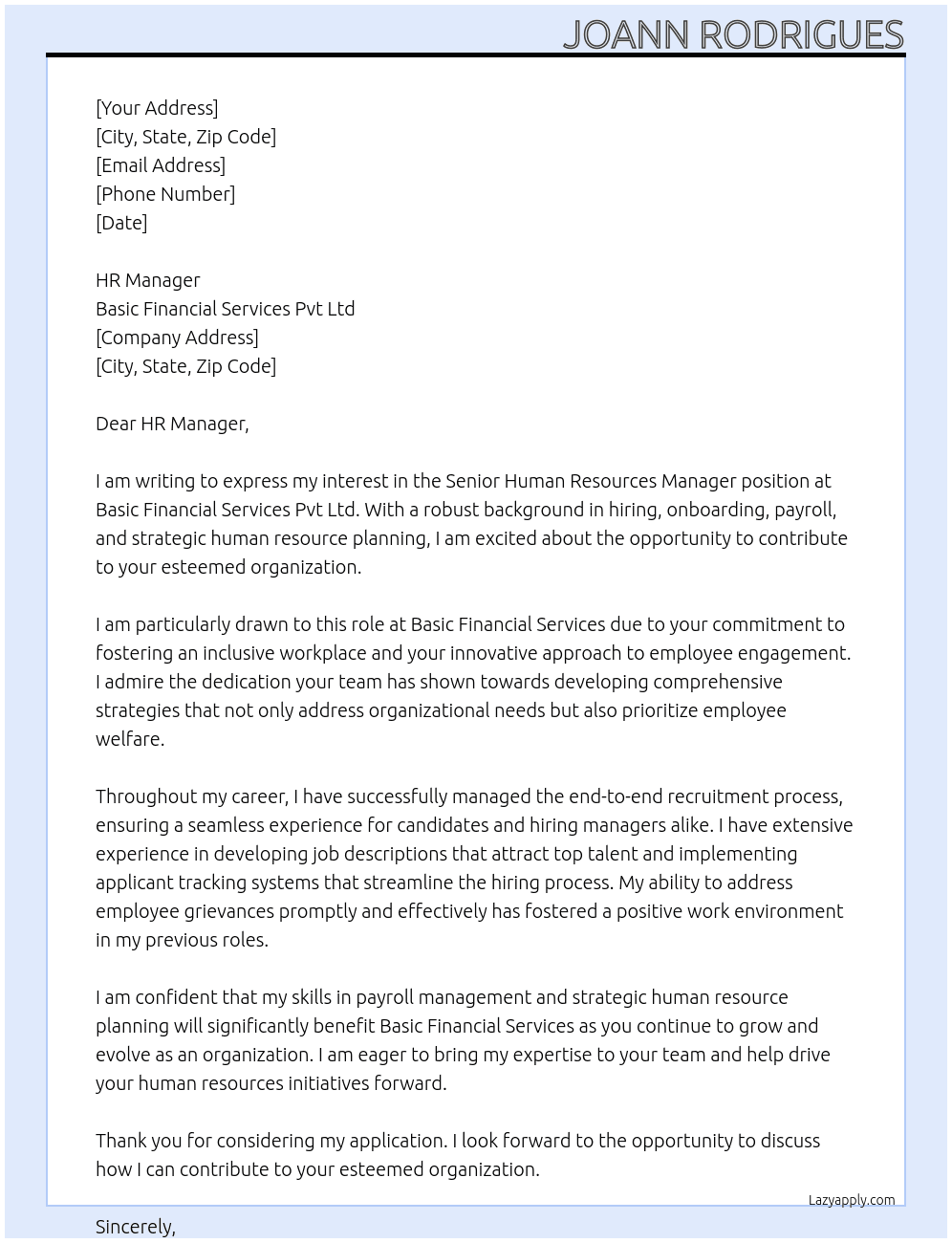
I am writing to express my interest in the Senior Human Resources Manager position at Basic Financial Services Pvt Ltd. With a robust background in hiring, onboarding, payroll, and strategic human resource planning, I am excited about the opportunity to contribute to your esteemed organization.
I am particularly drawn to this role at Basic Financial Services due to your commitment to fostering an inclusive workplace and your innovative approach to employee engagement. I admire the dedication your team has shown towards developing comprehensive strategies that not only address organizational needs but also prioritize employee welfare.
Throughout my career, I have successfully managed the end-to-end recruitment process, ensuring a seamless experience for candidates and hiring managers alike. I have extensive experience in developing job descriptions that attract top talent and implementing applicant tracking systems that streamline the hiring process. My ability to address employee grievances promptly and effectively has fostered a positive work environment in my previous roles.
I am confident that my skills in payroll management and strategic human resource planning will significantly benefit Basic Financial Services as you continue to grow and evolve as an organization. I am eager to bring my expertise to your team and help drive your human resources initiatives forward.
Thank you for considering my application. I look forward to the opportunity to discuss how I can contribute to your esteemed organization.
Sincerely,
Joann Rodrigues
Senior Human Resources Manager Cover Letter At Azadea Group logo Azadea Group
Azadea Group logo Azadea Group
Amman, Jordan
The Senior Human Resources Manager is responsible for leading and overseeing the HR department
as well as defining
developing
and implementing HR plans
policies
and procedures. He/she contributes to the creation of corporate HR strategies to align with the organization’s business requirements. Key Responsibilities Implement the overall strategy defined by the group
develop a local strategy to facilitate HR functions
and support day-to-day operations accordingly. Create action plans based on strategic needs and support growth or crisis resolution issues. Monitor and align operational requirements with all HR functions accordingly. Monitor all HR functions to ensure compliance with local labor laws and adherence to established standards and KPIs. Develop and maintain strong working relationships with internal and external parties to ensure the smooth delivery of HR services across the organization and enhance the company's external image. Act as the company's ambassador at public events
engaging with the audience
partners
public authorities
and other stakeholders to foster a positive image of the organization
in alignment with the CHRO. Manage the recruitment process for key and managerial positions in coordination with the recruitment team
ensuring the selection of qualified candidates. Conduct regular field visits to departments and shops
meeting with employees to nurture the group's culture. Prepare the HR department's annual budget and business plan and implement projects and events accordingly. Create
implement
and oversee a set of operational metrics to measure the effectiveness of the department across all functions. Address and resolve employee grievances
whistleblowing cases
and conflicts in alignment with the company's internal rules and regulations. Develop
generate
and analyze regular HR reports (e.g.
monthly
quarterly
and annually) to provide insights into key HR matters. Create targeted attraction and retention strategies to enhance employee engagement and satisfaction. This includes initiatives related to career development
recognition and wellness programs
work-life balance
competitive compensation
and improving workplace culture. Recruit
train
motivate
and evaluate the team to ensure that the department has the necessary skill base
and that staff are optimally motivated and enabled to maximize their potential and contribution to the company.
By Rula T. Sallam
[Your Name]
[Address]
[City, State ZIP Code]
[Email Address]
[Today’s Date]
[Hiring Manager's Name]
Senior Human Resources Manager
Azadea Group
[Company Address]
[City, State ZIP Code]
Dear [Hiring Manager's Name],
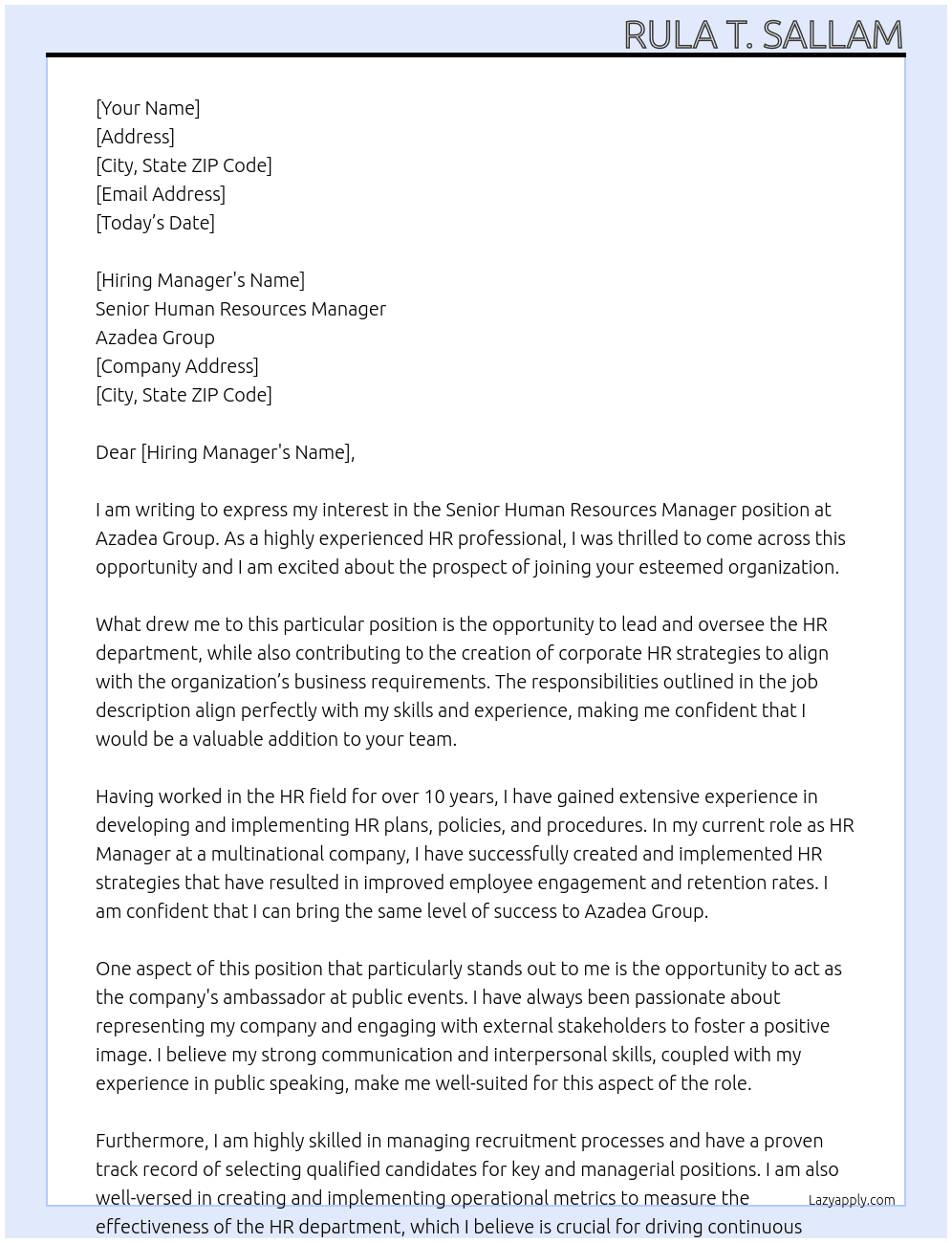
I am writing to express my interest in the Senior Human Resources Manager position at Azadea Group. As a highly experienced HR professional, I was thrilled to come across this opportunity and I am excited about the prospect of joining your esteemed organization.
What drew me to this particular position is the opportunity to lead and oversee the HR department, while also contributing to the creation of corporate HR strategies to align with the organization’s business requirements. The responsibilities outlined in the job description align perfectly with my skills and experience, making me confident that I would be a valuable addition to your team.
Having worked in the HR field for over 10 years, I have gained extensive experience in developing and implementing HR plans, policies, and procedures. In my current role as HR Manager at a multinational company, I have successfully created and implemented HR strategies that have resulted in improved employee engagement and retention rates. I am confident that I can bring the same level of success to Azadea Group.
One aspect of this position that particularly stands out to me is the opportunity to act as the company's ambassador at public events. I have always been passionate about representing my company and engaging with external stakeholders to foster a positive image. I believe my strong communication and interpersonal skills, coupled with my experience in public speaking, make me well-suited for this aspect of the role.
Furthermore, I am highly skilled in managing recruitment processes and have a proven track record of selecting qualified candidates for key and managerial positions. I am also well-versed in creating and implementing operational metrics to measure the effectiveness of the HR department, which I believe is crucial for driving continuous improvement.
I am also impressed by Azadea Group's commitment to creating a positive workplace culture and providing employees with opportunities for career development and work-life balance. These are values that I strongly believe in and have implemented in my previous roles. I am excited about the prospect of contributing to these initiatives and making a positive impact on the organization and its employees.
In terms of location, I have a strong preference for Amman, Jordan. Having lived and worked in the region for several years, I am familiar with the local labor laws and cultural dynamics, which I believe will be advantageous in this role. I am also drawn to the vibrant and diverse business landscape in Amman, which I believe will provide ample opportunities for professional growth and development.
In addition to my skills and experience, I am confident that my passion for HR and my strong work ethic make me a great fit for this role. I am a self-motivated and results-driven individual, and I am constantly seeking new challenges and opportunities to learn and grow. I am confident that I can bring a fresh perspective and innovative ideas to the HR department at Azadea Group.
I am excited about the opportunity to discuss my qualifications and how I can contribute to the success of your organization in more detail. Thank you for considering my application. I look forward to hearing from you soon.
Sincerely,
[Your Name]
Senior Human Resources Manager Cover Letter At Sonova AG
Sonova AG
Zürich
I possess a unique combination of higher technical education and and MSc in organizational psychology education
seasoned Manager with over 18 years of experience in leadership roles
various HR domains
such as recruitment and talent management
with a strategic vision
technology transformation
Aware of and responsive to the dynamics and initiatives at the headquarters and local level Open-minded
ambitious
and positive in facing challenges
business strategy
business development
organization development
global program management experience
People Development & Leadership; Project management; Management skills; Operate in a matrix environment; Problem-solving skills; Outstanding communication skills; stakeholder management
influencing
and consulting
Strong organizational skills; Independence in work; Cross-functional collaboration; Presentation skills; Experience in leadership and employee development programs; Data analysis and reporting; Mentorship and Coaching skills; HR related responsibilities 20+ years experience in an industrial setting
By Yuliya
[Your Name]
[Address]
[City, State ZIP Code]
[Email Address]
[Today’s Date]
[Employer’s Name]
[Company Name]
[Address]
[City, State ZIP Code]
Dear Sonova Team,
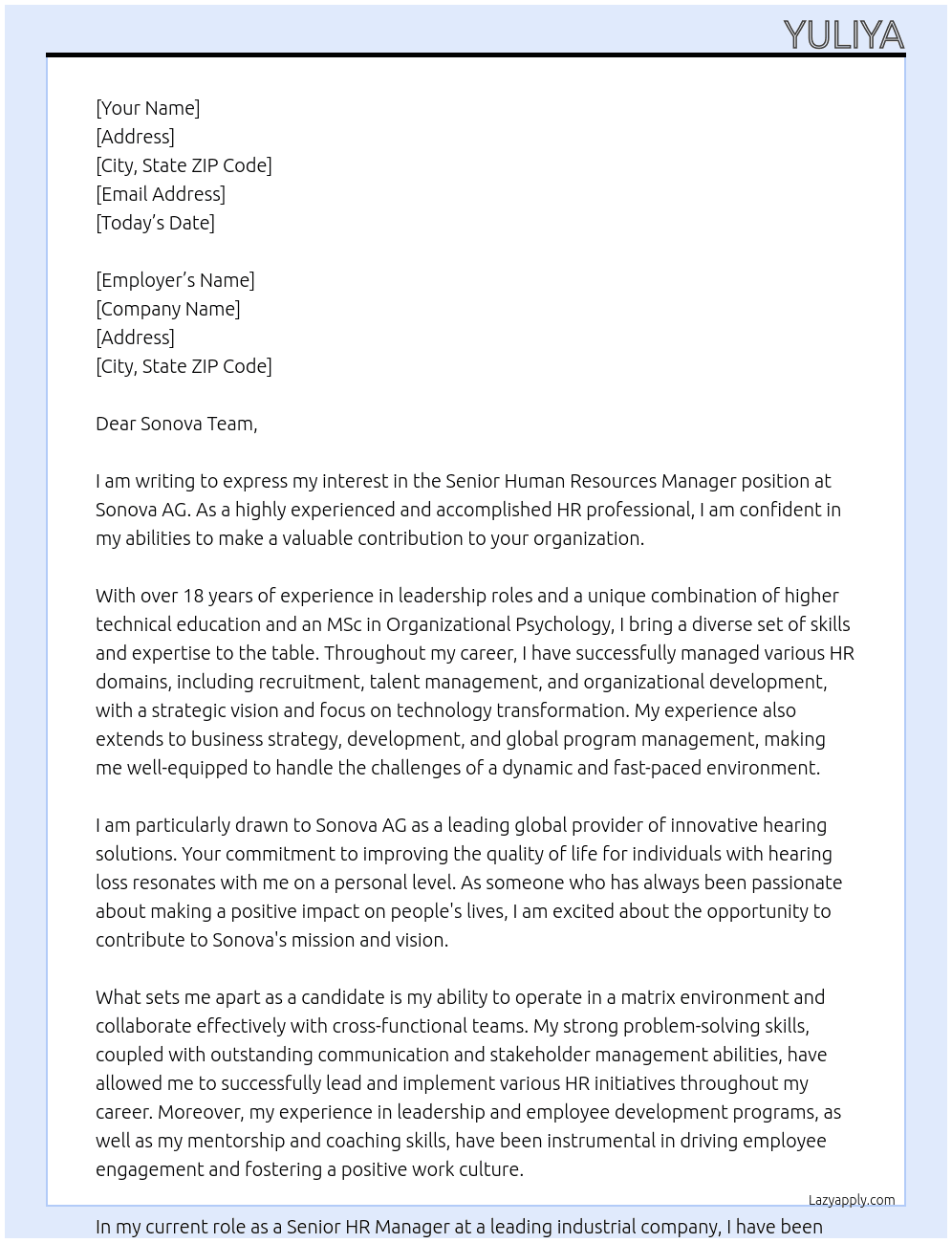
I am writing to express my interest in the Senior Human Resources Manager position at Sonova AG. As a highly experienced and accomplished HR professional, I am confident in my abilities to make a valuable contribution to your organization.
With over 18 years of experience in leadership roles and a unique combination of higher technical education and an MSc in Organizational Psychology, I bring a diverse set of skills and expertise to the table. Throughout my career, I have successfully managed various HR domains, including recruitment, talent management, and organizational development, with a strategic vision and focus on technology transformation. My experience also extends to business strategy, development, and global program management, making me well-equipped to handle the challenges of a dynamic and fast-paced environment.
I am particularly drawn to Sonova AG as a leading global provider of innovative hearing solutions. Your commitment to improving the quality of life for individuals with hearing loss resonates with me on a personal level. As someone who has always been passionate about making a positive impact on people's lives, I am excited about the opportunity to contribute to Sonova's mission and vision.
What sets me apart as a candidate is my ability to operate in a matrix environment and collaborate effectively with cross-functional teams. My strong problem-solving skills, coupled with outstanding communication and stakeholder management abilities, have allowed me to successfully lead and implement various HR initiatives throughout my career. Moreover, my experience in leadership and employee development programs, as well as my mentorship and coaching skills, have been instrumental in driving employee engagement and fostering a positive work culture.
In my current role as a Senior HR Manager at a leading industrial company, I have been responsible for overseeing HR-related activities for over 20 years. This has honed my skills in data analysis and reporting, as well as my ability to make data-driven decisions to support business objectives. I am confident that my extensive experience in an industrial setting will be a valuable asset to Sonova AG.
Having closely followed Sonova's growth and success over the years, I am aware of and responsive to the dynamics and initiatives at the headquarters and local level. I am impressed by the company's commitment to employee development and providing a supportive and inclusive work environment. This aligns with my values and approach to leadership, and I am eager to be a part of such a positive and forward-thinking organization.
As a highly ambitious and open-minded individual, I am always looking for new challenges and opportunities for growth. My strong organizational skills, independence in work, and ability to adapt to change make me well-suited for the fast-paced and dynamic environment at Sonova AG. Additionally, my location preference for Zürich is a testament to my commitment to joining your team and making a positive impact in the local community.
In conclusion, I am confident that my skills, experience, and passion make me a strong candidate for the Senior Human Resources Manager position at Sonova AG. I am excited about the opportunity to bring my expertise and contribute to the success of your organization. Thank you for considering my application. I look forward to the possibility of discussing my qualifications further with you.
Sincerely,
[Your Name]
Senior Human Resources Manager Cover Letter At Recology
Recology
By Monica Tomchick
[Your Name]
[Address]
[City, State ZIP Code]
[Email Address]
[Today’s Date]
[Hiring Manager’s Name]
[Company Name]
[Address]
[City, State ZIP Code]
Dear Hiring Manager,
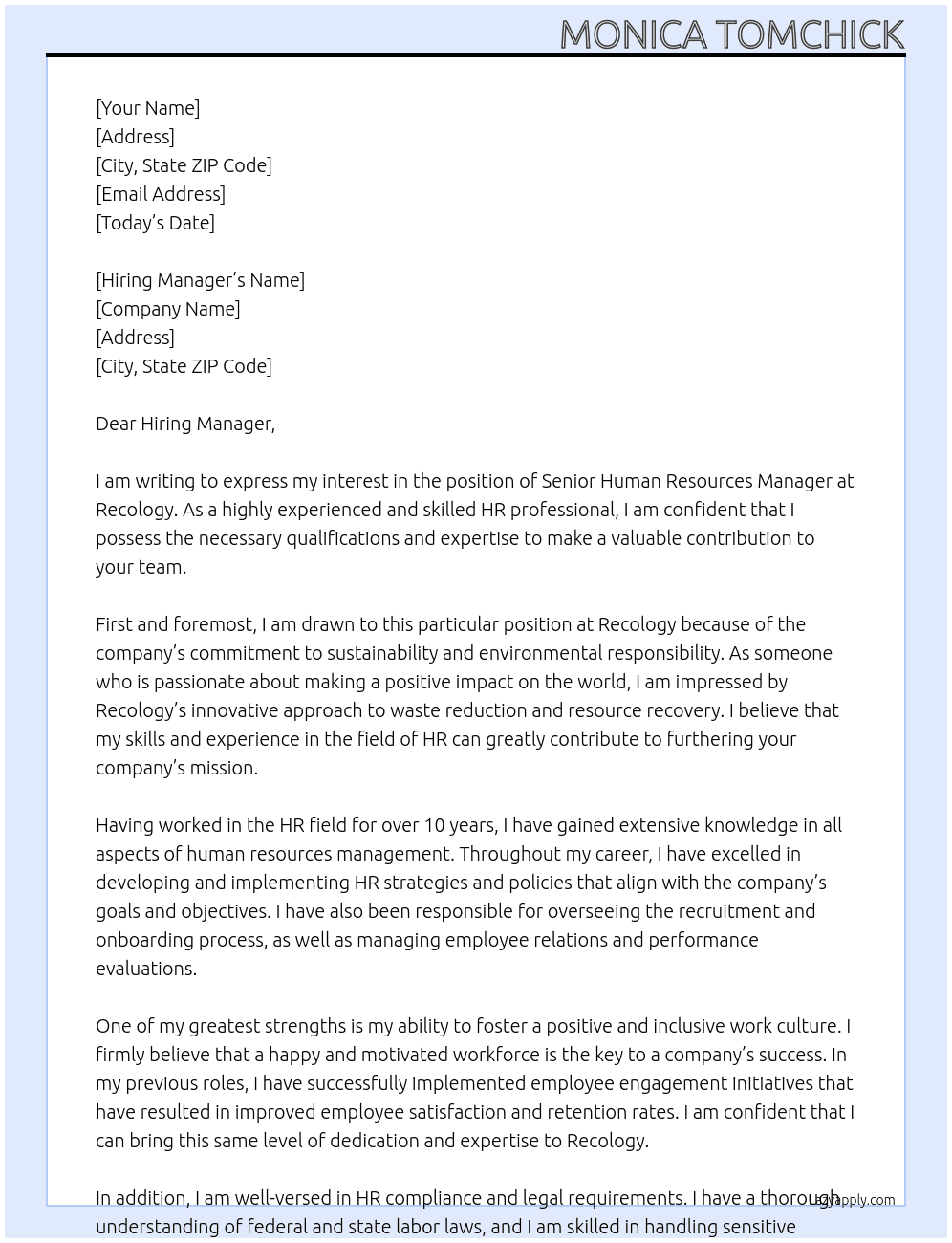
I am writing to express my interest in the position of Senior Human Resources Manager at Recology. As a highly experienced and skilled HR professional, I am confident that I possess the necessary qualifications and expertise to make a valuable contribution to your team.
First and foremost, I am drawn to this particular position at Recology because of the company’s commitment to sustainability and environmental responsibility. As someone who is passionate about making a positive impact on the world, I am impressed by Recology’s innovative approach to waste reduction and resource recovery. I believe that my skills and experience in the field of HR can greatly contribute to furthering your company’s mission.
Having worked in the HR field for over 10 years, I have gained extensive knowledge in all aspects of human resources management. Throughout my career, I have excelled in developing and implementing HR strategies and policies that align with the company’s goals and objectives. I have also been responsible for overseeing the recruitment and onboarding process, as well as managing employee relations and performance evaluations.
One of my greatest strengths is my ability to foster a positive and inclusive work culture. I firmly believe that a happy and motivated workforce is the key to a company’s success. In my previous roles, I have successfully implemented employee engagement initiatives that have resulted in improved employee satisfaction and retention rates. I am confident that I can bring this same level of dedication and expertise to Recology.
In addition, I am well-versed in HR compliance and legal requirements. I have a thorough understanding of federal and state labor laws, and I am skilled in handling sensitive employee issues with confidentiality and discretion. I am also experienced in conducting investigations and resolving conflicts in a fair and timely manner.
Furthermore, I am highly proficient in HR systems and software, including HRIS, ATS, and performance management tools. I am a quick learner and adapt easily to new technologies. I am also a strong advocate for continuous learning and development, and I constantly strive to stay updated with the latest trends and best practices in the HR field.
Aside from my professional qualifications, I believe that my personal values align with those of Recology. I am a strong advocate for sustainability and have actively volunteered for various environmental causes. I am also a team player and thrive in collaborative environments. I am confident that I will be able to fit in seamlessly with your company culture.
I am excited about the opportunity to bring my skills and experience to Recology and help drive the company’s success. I am convinced that my dedication, expertise, and passion make me a strong candidate for the Senior Human Resources Manager position. I would welcome the opportunity to discuss my qualifications and how I can contribute to your team in more detail.
Thank you for considering my application. I look forward to the opportunity to meet with you and learn more about Recology.
Sincerely,
[Your Name]
Senior Human Resources Manager Cover Letter At Jhpeigo
Jhpeigo
By Sarah
[Your Name]
[Address]
[City, State ZIP Code]
[Email Address]
[Today’s Date]
[CEO’s Name]
[Company Name]
[Address]
[City, State ZIP Code]
Dear [CEO’s Name],
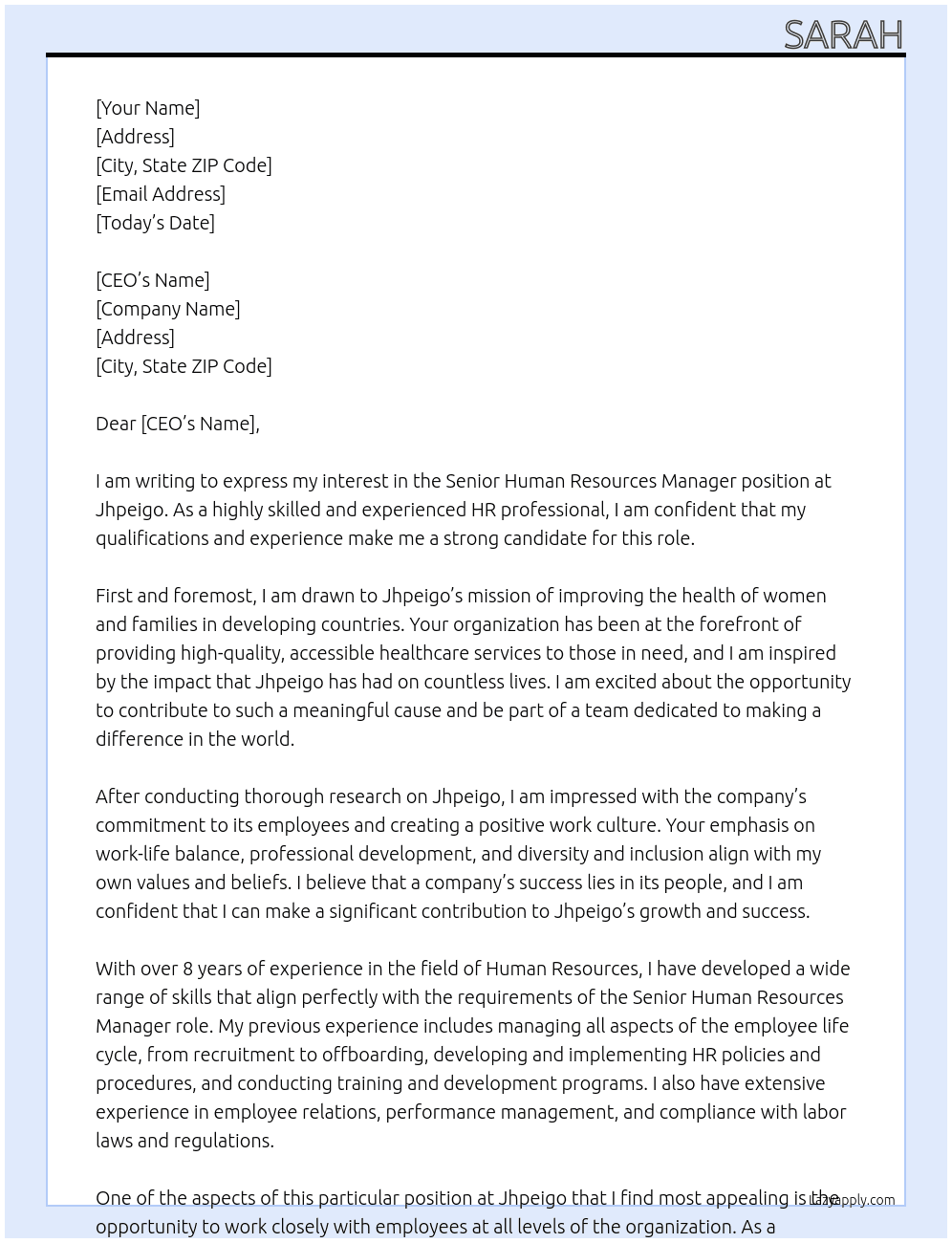
I am writing to express my interest in the Senior Human Resources Manager position at Jhpeigo. As a highly skilled and experienced HR professional, I am confident that my qualifications and experience make me a strong candidate for this role.
First and foremost, I am drawn to Jhpeigo’s mission of improving the health of women and families in developing countries. Your organization has been at the forefront of providing high-quality, accessible healthcare services to those in need, and I am inspired by the impact that Jhpeigo has had on countless lives. I am excited about the opportunity to contribute to such a meaningful cause and be part of a team dedicated to making a difference in the world.
After conducting thorough research on Jhpeigo, I am impressed with the company’s commitment to its employees and creating a positive work culture. Your emphasis on work-life balance, professional development, and diversity and inclusion align with my own values and beliefs. I believe that a company’s success lies in its people, and I am confident that I can make a significant contribution to Jhpeigo’s growth and success.
With over 8 years of experience in the field of Human Resources, I have developed a wide range of skills that align perfectly with the requirements of the Senior Human Resources Manager role. My previous experience includes managing all aspects of the employee life cycle, from recruitment to offboarding, developing and implementing HR policies and procedures, and conducting training and development programs. I also have extensive experience in employee relations, performance management, and compliance with labor laws and regulations.
One of the aspects of this particular position at Jhpeigo that I find most appealing is the opportunity to work closely with employees at all levels of the organization. As a people-oriented individual, I thrive in environments where I can build strong relationships with colleagues and provide support and guidance to help them reach their full potential. I am confident that my empathetic and approachable nature, coupled with my ability to handle complex HR issues, will enable me to build a positive and productive work environment at Jhpeigo.
In addition to my professional experience, I also possess a Bachelor’s degree in Human Resource Management and hold a certification in HR from the Society for Human Resource Management (SHRM). I am well-versed in HRIS systems and have experience using various HR software and tools. I am a strong believer in continuous learning and have attended several workshops and seminars to stay updated with the latest HR trends and practices.
I am also excited about the opportunity to work in a global setting at Jhpeigo. In my previous role at an international NGO, I was responsible for managing HR operations for employees in multiple countries, and I thoroughly enjoyed the cultural diversity and the challenges that came with it. I am confident that my experience and adaptability will allow me to excel in a similar role at Jhpeigo.
In conclusion, I am extremely enthusiastic about the Senior Human Resources Manager position at Jhpeigo and am confident that my skills, experience, and passion for the company’s mission make me a strong fit for the role. I look forward to the opportunity to discuss my qualifications further and how I can contribute to Jhpeigo’s success. Thank you for considering my application.
Sincerely,
[Your Name]
Senior Human Resources Manager Cover Letter At Grassroot Soccer
Grassroot Soccer
By Jeffrey Perry
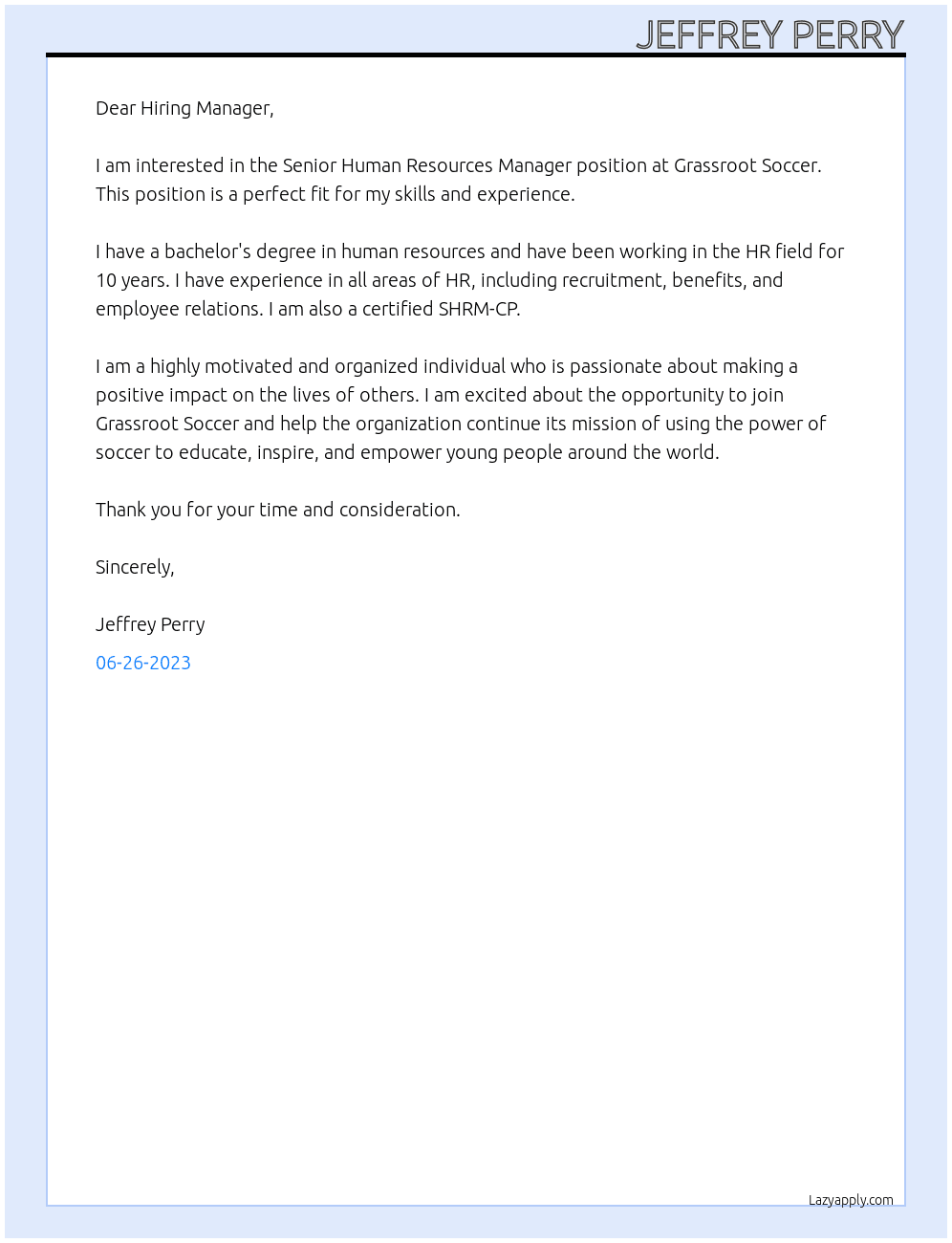
Dear Hiring Manager,
I am interested in the Senior Human Resources Manager position at Grassroot Soccer. This position is a perfect fit for my skills and experience.
I have a bachelor's degree in human resources and have been working in the HR field for 10 years. I have experience in all areas of HR, including recruitment, benefits, and employee relations. I am also a certified SHRM-CP.
I am a highly motivated and organized individual who is passionate about making a positive impact on the lives of others. I am excited about the opportunity to join Grassroot Soccer and help the organization continue its mission of using the power of soccer to educate, inspire, and empower young people around the world.
Thank you for your time and consideration.
Sincerely,
Jeffrey Perry